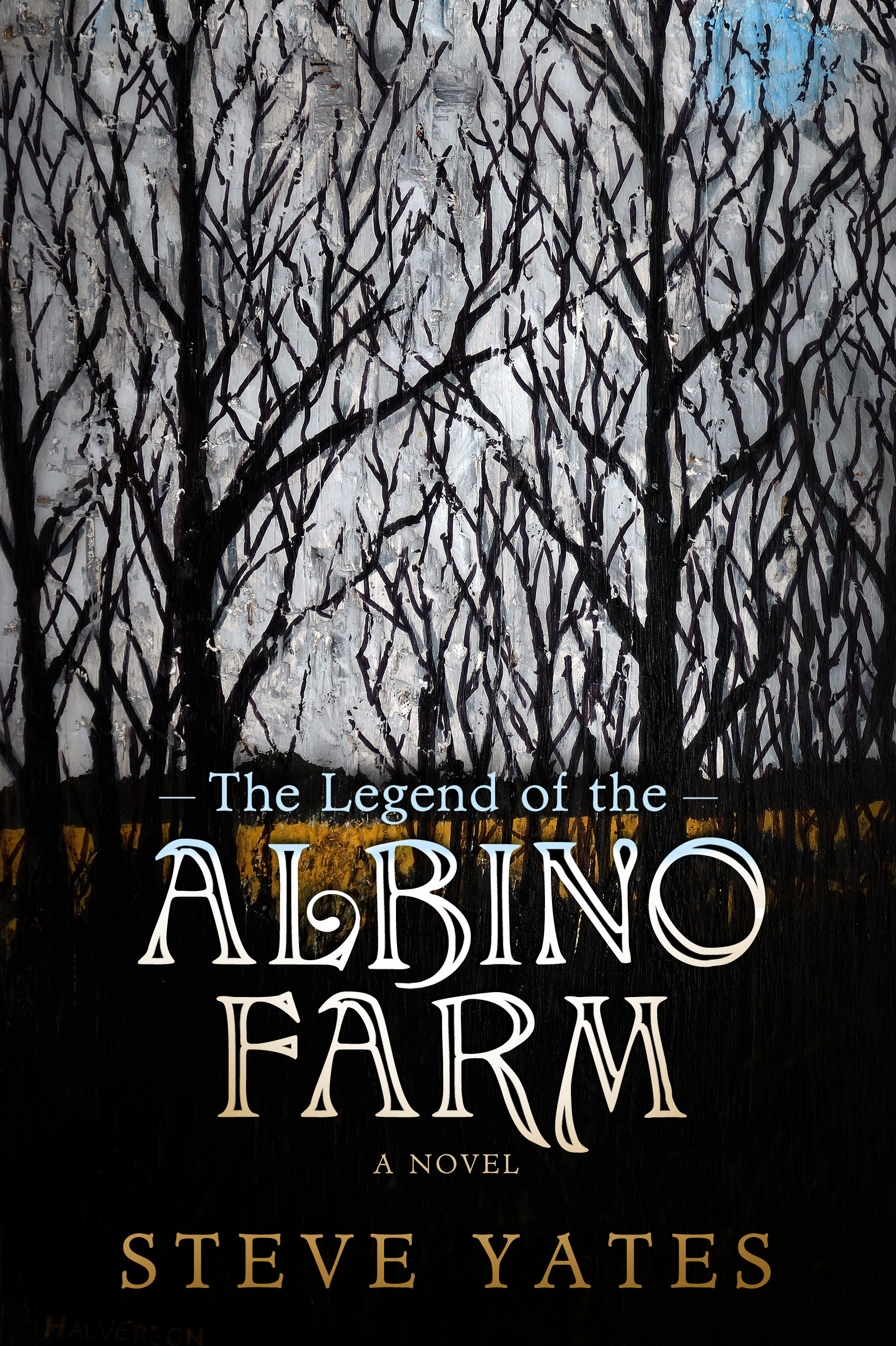
Praise for The Legend of the Albino Farm
Family myth and superstition mingle in the Ozarks in the talented new novel The Legend of the Albino Farm. One part Bridge to Terabithia, one part Bag of Bones, Steve Yates’s novel is full of haunting scenes and stories that blur the line between reality and nightmare.
Yates’s writing is confident and controlled. The lingo of the 1950s, as well as historic details, makes The Albino Farm almost disturbingly believable. Alternately wholesome and spine-tingling, the novel is full of surprises. Yates isn’t afraid to take risks, and the reward is an unusual, smart paranormal fantasy that effortlessly blends elements of the midcentury Midwest with classic ghost-story imagery.
In the end, it’s not Hettienne who’s the source of the family’s trouble—it’s something deeper. The Legend of the Albino Farm is satisfying, suspenseful, and full of good old-fashioned scares.
—Foreword Reviews March – April 2017, featured review Fantasy/Horror
“Yates’ characters embody personalities as flinty as the Ozarks soil they once farmed. And as their once-grand farm disintegrates, Yates gives us a fresh take on the plantation-gone-to-dust trope…. If the border state setting of Missouri might call into question The Legend of the Albino Farm’s southernness, the style and quality of Yates’ writing do not. In its attention to the details of domestic and family life, Albino Farm echoes the work of Katherine Ann Porter and Eudora Welty; the obduracy of the grown and estranged Hettienne calls to mind Ron Rash’s Serena…. With The Legend of the Albino Farm, Yates adds to a growing ouvre of historical fiction including his works Morkan’s Quarry and The Teeth of the Souls. He also adds another powerful novel to the growing body of Ozarks—and Mississippi—literature.”
—Matthew Guinn, author of The Resurrectionist and The Scribe in the Sunday Clarion-Ledger / Hattiesburg American Mississippi Books Page
Steve Yates has crafted a wonderful, suspenseful tale that will haunt and mesmerize its readers. The Sheehys are a grand old family from the Missouri Ozarks whose estate has fallen on tough times and become the source of local legend. Hettienne Sheehy is due to inherit the place but she has long suffered visions of terrible foreboding regarding her future there. As her story is told and her premonitions come true, the fragility of the human psyche and the power of myth to rule our lives is revealed. Like William Gay and Daniel Woodrell, Yates mines the fertile ground of his home state and constructs a world that the reader will not soon forget.”
—Cody Morrison, Square Books, Oxford MS
The Legend of the Albino Farm is a dazzling cautionary tale of the dangers of a self-fulfilling prophecy. In beautiful, hauntingly atmospheric prose, Steve Yates tells of the legends and myths that surround the slow fall into decrepitude of a once-magnificent family estate. The boundaries of fact and fiction, superstition and belief blur together in this complex and gripping novel, which suggests, ultimately, that perhaps families are the most unknowable mysteries of all.”
—Alex George, New York Times-bestselling author of The Good American and Setting Free the Kites
In the same way Faulkner built of his “postage stamp of earth” a realm at once richly mythological and firmly localized, so Steve Yates returns in this, his fifth book, to the haunted, haunting land of his childhood, the usually overlooked Missouri Ozarks. The Legend of the Albino Farm is about myths and legends, about inheritance and free will. Its compelling saga, rendered with lush and sometimes startling language, takes its readers deeply into itself and does not let them go.”
—Beth Ann Fennelly, author of Heating & Cooling, W. W. Norton, and Poet Laureate of Mississippi
The Legend of the Albino Farm drew me in from the first page. An enthralling and tragic tale, beautifully rendered.”
—Laura McHugh, author of The Weight of Blood and Arrowood.
Yates’ vision seems as much Shakespearean as Southern in this beautifully written blend of family saga and fantastical tale. He seems able to merge, as in a long strange dream, current times with the ever-present past. This world is put before us, inscrutably real.”
—Brad Watson, author of Miss Jane: A Novel, Aliens in the Prime of Their Lives: Stories, The Heaven of Mercury, and more.
The Legend of the Albino Farm is a rollicking tale of inherited demons, apocalyptic visions, loss, longing, and love—in other words, the story of a family, although told through the cracked lens of Yates’ wild, unblinking eye. This unconventional saga is a gripping, joyful read.”
—Sabina Murray, author of New York Times Notable Book Valiant Gentlemen and Pen/Faulkner Award Winner The Caprices
* * *
Praise for Sandy and Wayne: A Novella
Published February 2016
Dock Street Press in Seattle
ISBN: 978-0-9910657-5-2
156 pages, paperback original
Winner, inaugural Knickerbocker Prize from Big Fiction Magazine
Finalist, Faulkner / Wisdom Award for the Best Novella 2013
Finalist, Press 53 Open Award for the Best Novella 2012
Sandy and Wayne is tremendous, a taut, tense, magisterial work that has all the concision and sharpness of a great short story, all of the texture and detail of an engrossing novel. The novella is, in my opinion, the hardest fictional form to get right; Steve Yates has proven his mastery of this most gorgeous form.” Lauren Groff, author of three books, most recently Fates and Furies
It’s hard to imagine a less likely setting for a love story than on a dusty Arkansas road construction crew. But this author makes it work. Sandy and Wayne are as tough and hard-nosed as they come, so their romance is touching without ever being sentimental. Yates makes great use of his insider’s knowledge of this setting. In a way, the landscape itself is the star of this story—sometimes lush, sometimes severe and threatening.” Lisa Zeidner, author of five novels, most recently Love Bomb
A love story with soul, without sap, Sandy and Wayne is bursting with big-hearted wisdom and an admirable empathy for its characters and setting. Call it a novella; call it a short novel; call it a long short story—it doesn’t really matter. Just be sure to call it what it is: a stunning achievement by a writer at the peak of his powers.”—Andrew Roe, author of The Miracle Girl
Having proven himself a master of the novel and the short story, Steve Yates has set his sights on the novella. And lucky for us, his readers, that he has. Sandy and Wayne is a burst of adrenaline. At one point, as Sandy and Wayne attempt to save a man’s life, Sandy finds herself gripping Wayne’s shoulder, waiting to see if the man will open his eyes. Sandy and Wayne will grip you just that way. And won’t let go. And your eyes will be opened.” —David James Poissant, author of The Heaven of Animals
What a rare thing: a book that’s as compelling and complex a story about work as it is about love (and it’s a pretty great love story).”—Tom Nissley, author of A Reader’s Book of Days
* * *
Praise for The Teeth of the Souls
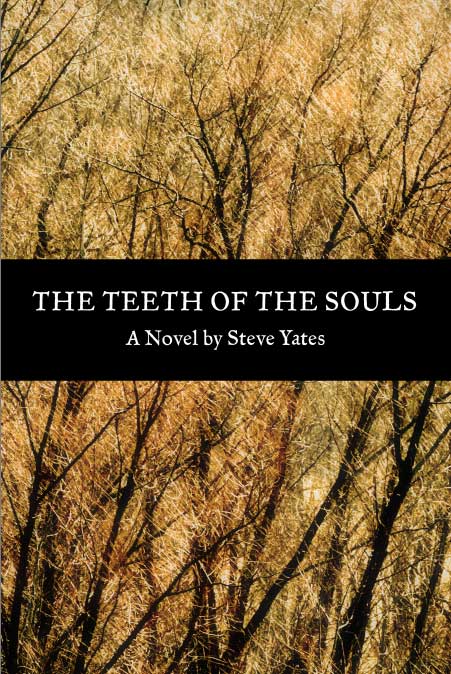
March 2015 from Moon City Press
Hardback ISBN 978-0-913785-53-9
Distributed by University of Arkansas Press
Steve Yates’s The Teeth of the Souls is gripping, well-plotted, and frighteningly authentic. Yates shows great courage as a writer who is not afraid to travel into dark places. With each new work, his craftsmanship matures, and he shows himself to be a true Son of the Border. I believe it time he be acknowledged as one of our premier contemporary historical novelists.”
Howard Bahr, author of Pelican Road, The Judas Field, The Year of Jubilo, and The Black Flower
Steve Yates searches out the hidden stories from our regional history. Those events that were murky in the shadows, forgotten, or simply not spoken about, are in his hands turned into powerful and fresh fiction. Yates has scope to his ambitions, and talent to match. An exciting new voice.”
Daniel Woodrell, author of The Maid’s Version: A Novel, Winter’s Bone, Outlaw’s Album: Stories, Woe to Live On, and many more
Steve Yates has been one of my favorite short story writers for years. But now, with The Teeth of the Souls, he’s becoming one of my favorite novelists. I can’t recommend him highly enough.”
Tom Franklin, author of Poachers, Hell at the Breech, Smonk, Crooked Letter, Crooked Letter, and (with poet Beth Ann Fennelly) The Tilted World
Through beautiful language, sharply-etched characters, and keen detail, The Teeth of the Souls brings back to life a forgotten nightmare episode of American history. And in the telling, compels its readers not to repeat the sins of our fathers—and mothers.”
—Matthew Guinn, author of The Resurrectionist
…colorful scene setting and doomed characters hook your interest immediately.
Even from the very first page, it’s clear that Leighton’s path to success won’t be an easy one as he has to choose between the true love of his life—his life-long friend and former slave, Judith—and a practical and beneficial marriage that would bring Leighton social rank and land.
Page after page, the reader is torn between rooting for Leighton and hating his inability to take a real stand as the tide of social change starts to hit the shore. The Teeth of the Souls is a tale of love, lust, hatred, tension, change and desire all set in the rugged landscape of the Ozarks.”
—Ettie Berneking, 417 Magazine
As an epic of early twentieth century progress and change, Yates’s book has the heft and atmosphere of those great novels from the period, with a lustiness and fleet regard for the modern reader, calling to mind a recent favorite, Ron Rash’s Serena, which finds an equal here. Like Rash, Yates can pass easily between the rugged and elegant. This facility is evident in his resplendent prose, which lavishes but never belabors, giving industrial metaphor — a katydid chirps “like a chain straining in a hoist,” while Leighton’s accountant, trussed up in prosthetics from his war injuries, is “an unholy contraption daily manufactured” — as easy as suppler comparisons — a woman’s shoulders are composed of “long, thin bones arranged like the struts of an exotic kite,” and the whiskey “smelled like autumn sunshine.”
The characters too are expertly drafted, moving with grand and organic purpose, like figures from history, speaking a poetry of inspired dialogue. “Sometimes I feel I have inside me a famous soul from a thousand years ago,” says Patricia, rubbing her pregnant belly, and then later laments, “The mind can talk the heart through acres of male weakness.”
And while it is most definitely a story of a time and place, the novel is, at its walloping heart, a romance and a tragedy, both tender and tough in its depiction of a lifelong quest for love in the wake of a convenient marriage and the painful repercussions of indiscretion.
Like the sturdy, ornate architecture of its age, “The Teeth of the Souls” was built with a craftsman’s patience and exacting, its components forged from the finest material. A thing of integrity, built to last.”
—Jamie Kornegay, The Clarion-Ledger. Kornegay is the owner of Turnrow Book Co. in Greenwood. His debut novel, Soil, was just released by Simon & Schuster.
While Steve Yates’s latest novel is deplete of vampires, zombies or wizards, it will still find its way into the hearts of many readers looking for a long narrative to cozy up with this fall. At more than 450 pages, The Teeth of the Souls is a behemoth of a tale about Leighton Shea Morkan and his life in Springfield after the Civil War. Yates’s newest historical fiction is the follow-up to his first novel, Morkan’s Quarry, the story of Leighton’s father and the settlement of the Missouri backwater. The Teeth of the Souls is a rich narrative that is heartwarming and heartbreaking all at once.
Yates, a Missouri native who lives in Jackson and is marketing director at the University Press of Mississippi, continues the fictional saga of the Morkans with plenty of tense moments that reveal past lies and present deceit. It also provides deeply developed, if somewhat doomed characters set among colorful scenes and landscapes.
The novel begins immediately after the Civil War with Leighton, who fought for the Union, as heir to a war-ravaged limestone quarry in the village of Galway, Missouri, near Springfield, now fighting to keep his legacy afloat. This legacy, left by his father, is disordered and in need of a huge influx of finance. Leighton’s attempts to collect on old debts owed to his family gain him little funds, a lot of headaches, and eventually a young wife. This new addition to the Morkan family not only complicates matters for the broken and generally stoic anti-hero, it also provides a breath of fresh air to Yates’s otherwise dark story.
Without a doubt, it is Leighton’s love triangle with Patricia, his new 14-year old bride, and Judith, his life-long friend and former slave, which will hook readers’ interest immediately. Leighton’s practical and beneficial marriage to a broke German banker’s daughter brings him social status, but more importantly financial security in the form of his wife’s dowry, a tract of mineral-rich land. It also brings Leighton a complex and surprisingly wise wife.
When his spitfire lover, Judith, mocks the union by cleverly asking, “So you done gone marry that land over yonder,” Leighton merely raises an eyebrow (120). But, he quickly realizes Judith is not the only strong-willed woman in his life. Immediately after claiming his new bride, the young woman demands to know, “Why did you ever marry me?” (132). His honest answer, “I wanted the land. Five hundred sixty acres. That lime under it,” causes his new bride to cry hysterically. A flustered Leighton yells, “Look, why are you crying? Here you wallop me and want the truth.” Leighton palms his face and raises both eyebrows when Patricia hiccups and calmly replies, “You know, I think sometimes I will like to be lied to” (133).
Indeed, it is Yates’s swelling tension peppered with moments of colorful humor that makes The Teeth of the Souls more than a historical novel. It is clear, page after page, that Leighton’s path to financial success won’t be easy, nor will choosing between the true love of his life and his child-bride, whom he reluctantly and painfully grows to respect.
Howard Bahr, author of Pelican Road, The Judas Field, The Year of Jubilo, and The Black Flower, acknowledges Yates’s The Teeth of the Souls as “gripping, well-plotted, and frighteningly authentic.” Bahr adds that Yates shows “great courage as a writer who is not afraid to travel into dark places.” It is those dark places that also make Yates’s third novel a winner. Readers will find themselves cheering for Leighton’s ability to save his family legacy, while at the same time hating his inability to take real stands as a leader of social change. Likewise, readers will love Leighton, who goes against his peers and his late father’s wishes to pay a living wage to freedmen, and hate Leighton, who proves to be no real hero after he joins a masked vigilante group reminiscent of the KKK. Leighton Morkan is, without a doubt, a young man trapped between being his own man and being the son of a slave owner.
The Teeth of the Souls is no easy read, but is expertly drafted with wonderful dialogue and unforgettable characters. It is an epic about love, lust, hatred, and tension all set in the backdrop of early twentieth century progress and change.
—Deb Payne Purnell, Valley Voices: A Literary Review, Fall 2015
After the Civil War, young Leighton Shea Morkan inherits the Morkan Quarry outside of Springfield, Missouri. To make a profit, he hires many free black men to operate the mine, which causes a furor among the town’s white residents. The miners work for a lesser wage than white workers and are paid in script, which entitles them to necessities sold at the company store.
Leighton falls in love with Patricia Weitzer, daughter of a trustee of the National Mineral Bank, to whom he had owed money. This marriage arrangement rids him of the loan and adds land to his own acreage. Unbeknownst to Patricia, Leighton is having an affair with Judith, an older woman and former slave of the Morkans. Leighton and Patricia’s marriage did not sit well with Judith.
This is a sequel to Morkan’s Quarry, which had followed the narrative of Shea Morkan’s father, who had established the stone quarry prior to the Civil War. The racial tension between the blacks and whites in Springfield provides a fascinating glimpse of unrest in post-Civil War America. Vigilantes and the upcoming railroad increase the tension within the Springfield community. The characterizations are complex and realistic for the time period. This is an exceptional read that brings the Reconstruction period to life. Highly recommended.
—Jeff Westerhoff, Historical Novel Review, Issue 76: May 2016
In post-Civil War Missouri, Leighton Shea Morkan, the son of an Irish immigrant, navigates a world torn by bitter conflict, while confronting his own inner conflicts. Poetic and profound, The Teeth of the Souls is an extensively researched and vividly imagined sequel to 2010’s Morkan’s Quarry, author Steve Yates’s debut novel. While it can stand alone as a masterful work, this new book certainly makes a deep-seated impression when paired with its predecessor. Together, the two form an epic that delivers more than eight hundred pages.
—Missouri Life, June 2016
 Fiction and History
One response to “Praise for The Legend of the Albino Farm”
[…] Praise for The Teeth of the Souls […]