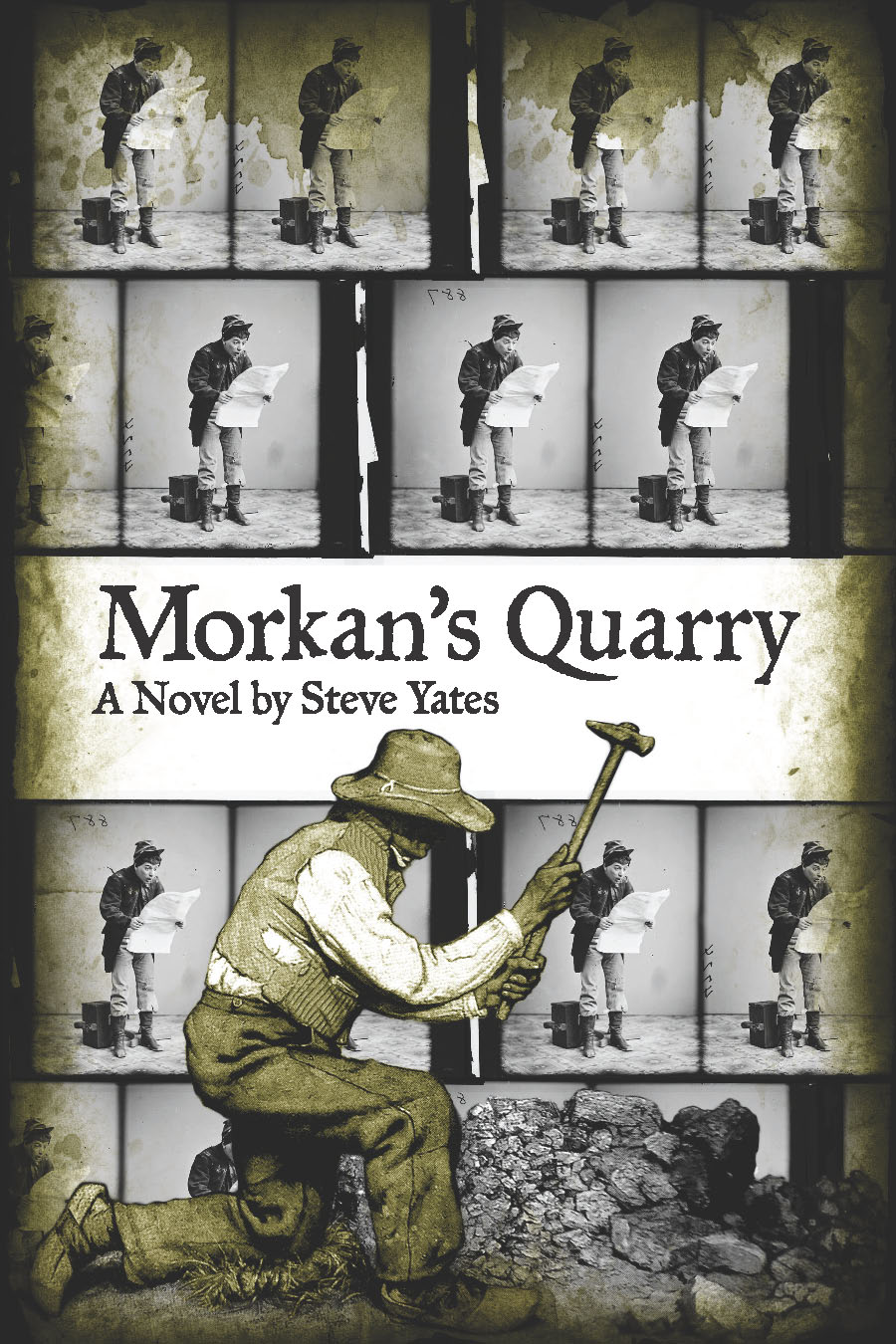
 While I have not heard how Friday morning’s panel at the Words & Music Festival will be run, I figured I had better take some notes and share them here. I’m sure Howard Bahr, Roy Blount Jr., and Dr. Alecia P. Long will have plenty to say. 6-1 odds I won’t need any of this!
NOTES ON CIVILIANS IN THE OZARKS DURING THE CIVIL WAR
Today I’ll be drawing almost everything in my part of this discussion from three great books that helped me understand my home country and the war’s effect on civilians, and inspired me to write my novel Morkan’s Quarry.
Fellman, Michael Inside War: The Guerilla Conflict in Missouri During the American Civil War (Oxford University Press 1989)
Keefe, James F. and Lynn Morrow The White River Chronicles of S.C. Turnbo: Man and Wildlife on the Ozarks Frontier (University of Arkansas Press 1994)
Piston, William Garrett and Richard W. Hatcher III Wilson’s Creek: The Second Battle of the Civil War and the Men Who Fought It (The University of North Carolina Press 2000)
I’m very grateful and humbled that Rosemary James and Joe DeSalvo would ask me to be on a panel with two such distinguished writers as Howard Bahr and Roy Blount, Jr, and also scholar and author Alecia P. Long. And I’m grateful that Ozark hillbillies may briefly get a say. The story of the Civil War in the Ozarks is almost entirely unknown. And if a scintilla of it is known by anyone outside the Ozarks, by outworlders, by the non-hillbillys, then the bloody, awful savagery that was the war in the Ozarks is quickly swept aside in favor of the romantic, Robin Hood story of Jesse James, who was not from or of the Ozarks. I daresay that Americans know as much about the Civil War in the Ozarks as Europeans know of World War I in the Balkans.
An unfair, unlikely comparison, you say? Hmm.
Both are mountainous, isolated regions, filled with backward, clannish, peculiar people, some of whom held longstanding grudges. While no grudge in the Ozarks can match the longevity of the Bulgar or Serb’s 500-year vendetta against an Ottoman Turk, we were and are quick studies.
Both regions were arguably where wars started. World War I started in the Balkans as major powers of the day—especially Austro-Hungary and Russia—became increasingly then belligerently involved in local wars and politics. In Missouri, we were busily at each other’s throats and the throats of neighbors in Kansas seven years before the rest of you all took up the sword. Some persnickety history buff is already squirmingly ready to correct and say that the Ozarks was not part of the Bleeding Kansas border conflict. Oh really? Many of the major players of the war in Missouri and Arkansas, which was fought mostly in the Ozarks, cut their teeth in Kansas. See Christopher Phillips’s outstanding biographies of General Nathaniel Lyon and of Missouri Governor turned Rebel Claiborne Fox Jackson to understand. If the bloodbath of popular sovereignty went undecided during regulation play in Kansas, then the Civil War in the Ozarks was four years of savage overtime.
Both regions, the Balkans and the Ozarks, suffered a collapse of civil authority and the institution of capricious and often brutal martial law conducted by distracted occupiers. The majority of resources to maintain order and security were needed and sent elsewhere in both conflicts. Montenegrin and Serbian civilians suffered terribly under Austro-Hungarian martial law. And Ozarkers long suffered under a Union control that maintained some secure garrisoned outposts but could not bring the vast countryside, the brush, to justice and domestic tranquility.
And, last, both regions are by history forgotten, deliberately I think, it being too painful to consider for long that such suffering was visited on any people for no discernible gain. And forgotten because the people, having suffered terribly and having often been betrayed by neighbors, did not and do not encourage much real remembering.
Civilians in the Ozarks suffered from all quarters. Missouri and especially the Ozarks were divided in a way that few historians write carefully about. Historians in haste usually describe the Missouri countryside as “bitterly divided.” So with our blue and gray bifocals fixed squarely on our noses, we think they mean an angry 50-50 split. Not so. In the 1860 election, 17,028 Missourians voted for Abraham Lincoln, 31,317 Breckenridge, 58,801 Douglas, and 58,372 Bell. In Greene County 42 voted for Lincoln, 414 for Breckenridge, 298 Douglas, 986 for Bell. The whole of the state, then, would very narrowly have gone for the conditional unionist and Northern Democrat Stephen Douglas, and closely given second to John Bell, the slaveholding Whig from Tennessee, also a conditional unionist. A majority of the voters then in Missouri and the Ozarks chose candidates who were for the status quo, which included slavery, but more important to the voters included peaceful, continued compromise within the Union. When the question of even holding a secession convention was put to vote in March 1861, 73% voted against seceding. So Ozarkers were not a divided 50-50, but a majority of centrist, status quo yeoman trapped between the screaming, belligerent minorities of slave-holding rich elites and abolitionists and German-Americans from St. Louis (fully 9,000+ of those 17,000 votes for Lincoln were from that one demographic).
In that March 1861 voting on whether or not to hold a secession convention in Missouri, unionist candidates outpolled secessionist candidates 73% to 23%. Sources did not tell me how the missing 4% in that statistic voted, so I’ll say they were Ozarkers running on the “I’ve had it with all of you’ns” or the “Quiet’n down” ticket. Those two tickets may be in jest, but the joke gets at the heart of Missouri Ozark attitudes to the American Civil War at its outbreak. According to Michael Fellman in his great book Inside War: The Guerilla Conflict in Missouri During the American Civil War, the average Ozarker was a hill farmer whose people migrated recently from Tennessee or Kentucky. Almost all these stats come from his mighty work. Fellman says the Ozarks hillbilly was as “bitterly negrophobic” as he was deeply resentful and suspicious of the elite Southern planter class and that caste’s “pretentious” Missouri counterparts in the Boon’s Lick. In Missouri Confederate: Claiborne Fox Jackson and the Creation of Southern Identity in the Border West, Christopher Phillips argues that Missourians of the day largely considered themselves vanguard Westerners, and not southerners or northerners.
Very soon in the war this leave-me-be middle ground went through hell. On August 10, just outside of Springfield, my hometown and where my novel Morkan’s Quarry is set, from about 5 a.m. until late that afternoon, more than 17,400 men fought in the Battle of Wilson’s Creek, 12,000 Confederate and 5,400 Union soldiers. That evening of the 10th and late into the night, the defeated, exhausted Federal forces poured into town. And on August 11, confused, shattered, infuriated, desperate, and lacking firm leadership, that Federal army sloughed its many wounded and dying into our courthouse and our churches and our homes, removed all it could carry of local goods and foods, and took all the currency from the banks in town. Many families with Union sympathies began hastily packing their households and were soon clogging the streets. Civic authority largely collapsed, and a chaotic military and civilian exodus for the safety St. Louis began. Bedlam. For the first time citizens with little experience of bloodshed and killing, of mortally wounded men, were nearly outnumbered by the wounded and dead of both sides. August 11 was just the start of Springfield’s terrible ordeal.
From July through December of 1861, Springfield changed hands five times and was occupied by six different armies. After that half the town’s population had left, and half the buildings in town were uninhabitable or unusable. There was one more serious battle inside the city limits in January of 1863, and for most of the war the town became a Union garrison, supply post, and hospital tent city. Again and again in the White River Chronicles of S. C. Turnbo you will find beleaguered Ozarkers, regardless of sympathies, fleeing to Springfield after a traumatic, life-threatening visit from brigands of unknown allegiance. And you find many of the refugee men joining Federal militias so as to have work and sustenance. Women at best labored hard to serve the armies there—diaries record countryside women toiling away to make flat cakes and baked goods to sell to Union soldiers even while guerilla brigands circled the city like vultures to rob the poor women of what they earned. Other diaries report unfortunates of both sexes wandering depraved and becoming alienados. Reason stayed long enough for them to flee the hills to Springfield. But they had seen brothers, sons, and fathers killed before them, and sisters and mothers tortured and beaten. In the seeming safety of my hometown, reason shattered and departed. Possibly a mercy considering what they had to remember.
Not knowing another’s allegiance and not being able to predict the behavior of those you encountered became a constant theme and a major cause of fear, flight, despair, and in some cases depravity and madness for civilians. Imagine, you are in your yard carrying water from the spring house, your mother on the porch pounding dust from a throw rug, brother and father are one hill over cutting timber. Out of the mist come seven riders, all with Federal blue coats, but long hair, grimy faces, and when they approach you notice scalps trailing from their tack, holes in their tunics where a ball has passed that would have surely killed the man wearing it. What comes next?
Just the story titles in White River Chronicles of S.C. Turnbo are enough to understand—Hardships and Starvation in the Days of War; Saving Her House Through Tears and Prayer; Visiting the Grave of Her Affiance; Reading the Bible by the Reflection of Light from a Burning Town.
For those not in the middle, the progress of guerilla war and its uncertainties actually intensified one’s sympathies. So Union families became more vocally and even violently pro-Union. Secessionist families became more radically and, when necessary, more violently pro-rebellion. All of this devoured the middle ground. Why? We all want to live in predictable, and preferably non-threatening relationships with those around us, as Fellman points out. Those who are unpredictable, whose loyalties and intentions and motivations remain unknown, are a greater source of anxiety than those whose actions and attitudes come from declared or discernible character and disposition.
This devouring and constant, violent uncertainty resulted in two psychological characteristics that Fellman points out in Inside War: 1) survival lying and 2) psychic numbness. Fellman found within the reams of testimony and diaries he digests that a great majority of Ozark civilians, regardless of their true sympathies, were not willing martyrs and stalwart heroes. To survive when under Union captivity or duress from guerillas, we lied. We were coerced into doing what irked our captors, forced by the other side, and had always been good and loyal whatever you need us to be, sir.
Psychic numbness is quite possibly the most awful manifestation Fellman points out. It is a state in which Missouri civilians, subjected to recurring, unpredictable violence from former neighbors and from both guerillas and undisciplined Union occupiers, unsure of the allegiances of others and finally of their own allegiances, found life “emptied of any inner meaning,” found greed for money and food an overpowering instinct, and found violence to be the accepted and new norm of many social transactions.
I do think this period caused some serious creases in the Ozark character, and certainly in the way that we related to history. Reticence, distrust of outsiders, and that vanguard western desire to light out for the territory and be free of things civilized was always a part of the hillbilly psyche. Well, we sure were glad youn’s from civilization could come and unleash this terrible mess on us. Thank ye! Surely you can imagine how the war described by Fellman, Keefe, Morrow, Turnbo, and Piston with Hatcher severely hardened hearts. Who would want to remember the real war or subject a child who had not seen it to tales of so much hate and destruction?
In fact, for those who experienced it firsthand, I think there was a willful silence and a determined forgetting about the war in the Ozarks. That’s why Morkan’s Quarry starts with the sentence: “When the war was finally won and the Morkans reclaimed their quarry after a fashion they did their best to forget the armies, the battles, and the occupations.”
Now imagine Ozarkers sitting around listening to stories of glorious battles fought elsewhere. That will be a short visit! And in the presence of a true war story, as Tim O’Brien says, a war story with “an uncompromising allegiance to obscenity and evil” one can see where Missourians and outsiders to the Ozarks would gladly take up the romantic story of the noble bushwhacker, a Robin Hood underdog fighting for a lost and chivalrous South that never really was. I’m going to leave you with a true war story from the White River Chronicles of S. C. Turnbo.
“One night while Mr. Baker and Jim was away from home, the band of heartless men rode up to the yard gate and dismounted and walked into the house and with threats and oaths they attempted to compel Mrs. Baker and Calvin to tell of the whereabouts of their money and other valuables which they refused to do. They then proceeded to whip the faithful woman with a drawing chain and hung Calvin by the toes to a joist in the house [Calvin is described only as ‘small,’ so he’s maybe 8-11]. Mrs. Baker was beaten almost to death with the chains before the brutes let up and Calvin suffered intensely before they let him down…. The bandits did not stop at this but finally killed Mr. Baker and his son Jim in a cruel manner. Mrs. Baker who had partially recovered from the terrible ordeal of being whipped with the chain had her husband and son buried under a large apple tree that stood in the corner of the orchard. After the close of the war she had the two graves and the apple tree enclosed with paling. Mrs. Baker bore ugly scars on her body, head and limbs to the day of her death and was subject to spasms that attacked her after she had underwent the brutal treatment inflicted on her by the bushwhackers and cutthroats. Mrs. Baker when her death occurred received interment in a graveyard on the bank of Bear Creek.”
Think of Mrs. Baker after the war. It’s Sunday, church is over, and there’s a little picnic and some music there in the holler south of Lebanon. She’s with Calvin, who is alone, unmarried. He has trouble walking and is not much of a prospect. But Mrs. Nan Baker is glad to be with her people, she sure likes the music and company, and she hopes very much that someone from around here will love Calvin one day, there’s many girls without men. And everything is fine until there’s a change in the breeze, some clouds darken the sycamores by Bear Creek. Nan begins shaking; she feels her lips and face clench up; she knows she can’t stop it. And so she rises and excuses herself and leaves Calvin and her people. She walks home and sits in her cabin, her body in full disobedience now; she’s alone, and she’s remembering crawling from the cabin to see the terrible scene in her yard. The whole world at an end. She’s remembering the apple tree and that white fence and those two graves. And she’s remembering Calvin screaming. And she is trembling.
The next time someone sells you a story on the grand and noble manly goodness of any bushwhacker or those who hunted them in the Ozarks, I want you to recall Nan Baker. And I want to thank you for listening to me and letting my people have a say about the war that is forgotten.
 Fiction and History
One response to “Notes on Civilians in the Civil War in the Ozarks”
[…] Joe DeSalvo at Faulkner House Books was the first intercessor, putting Howard as emcee of a vibrant panel on civilians and the Civil War and putting me dazed in a mix of much more famous and deserving authors on that […]