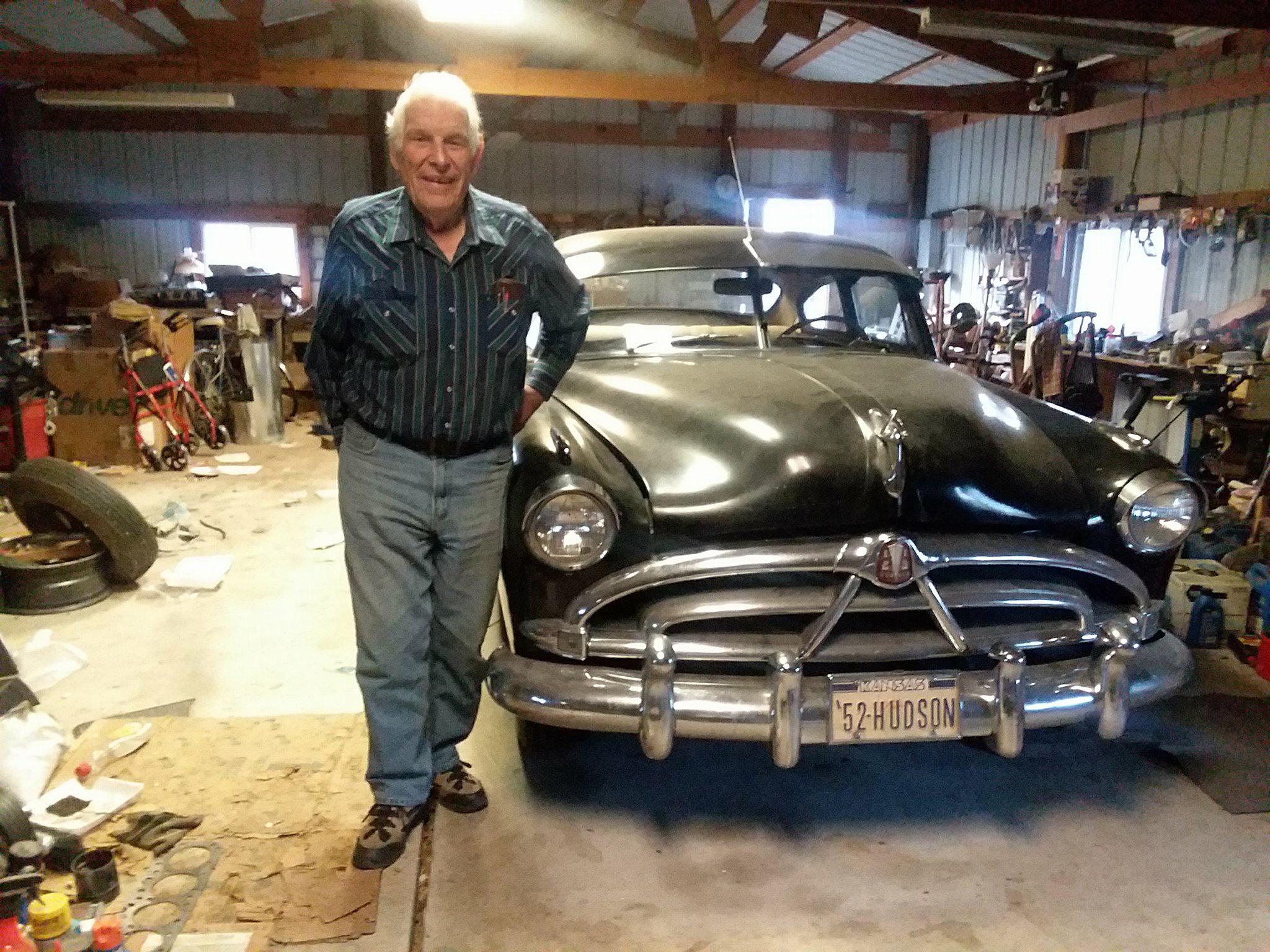
This is my Uncle Bert Yates next to his 1952 Hudson Wasp, a car he rebuilt and drove for years. Bertram worked for Beechcraft and then Boeing in Wichita, Kansas. He was the fascinating and mysterious uncle who could never tell us cousins a word about what his work entailed. It was classified, top secret. Long after retirement, at my grandmother Mary Yates’s funeral, he admitted his surprise that I felt so curious. He said, as if it were nothing special, that the last thing he worked on before turning in his keys and waving goodbye was an intricate camera for bombers, the first that could focus and see at night. He left it at that. When he asked me for a signed copy of “The Legend of the Albino Farm: A Novel,” I asked him to get this photograph made, one of him beside one of the many Hudsons he rebuilt. He had a business card he gave me once long ago that read: THE HUDSONITE FAMILY, as if restoring these lost automobiles solidified one into a sparkling, exotic mineral, Hudsonite. I love how the light in the photograph glows in his hair as if more and more lumens of inspiration and fire have suddenly alighted there.
Uncle James in The Legend of the Albino Farm: A Novel blends the love and company of all my uncles, I’m sure, maybe even some of the uncle I have been, or not been, to my nieces. The novel is dedicated to all my nieces. Here is one of Uncle James’s big scenes with his niece, Hettienne, from Chapter 5:
The coffee propelled James as did a worry like none he had ever experienced, an urgency beyond any foaling or calving. Half-an-hour after Charlotte checked on Hettienne and reported her asleep, the rest of the cranky clan returned home smelling of gunpowder, sweat, and hardwood smoke. They threw their fits and got in their last jibes. Finally all went to bed. But he sat up in the parlor with the kerosene lamp going and a good view of the stairs. To take his mind off Hettienne’s spells, he reread the stilted old novel about the shepherd of the hills and his daughter, a cozy comfort fiction filled with hillbilly characters unlike anyone he knew in the Ozarks. Just as he was coming to the big scene when the heroine fainted, James fell soundly asleep.
He jolted awake. All the comforting sounds of the house, the brassy clicking of the E. Ingraham wall clock in Simon’s southwest bedroom, the swish of curtains in the summer night’s breeze seemed a conspiracy to mask trouble. He crept up the stairs, peered through Hettienne’s open bedroom door. Her bed was empty, the sheets twisted in a wad.
Out the back window of the kitchen was a light up in the loft over the stables flickering where none belonged. James lifted as carefully as he could from the gun cabinet the .20-gauge Remington Model 11. He found a flashlight, bulky and heavy. Then he hustled to the back door. He never walked the grounds of Emerald Park at night in any season without the Remington, for vermin were ample in the dark, and the opossum could be vicious.
He eased down the back steps, the flashlight in his fist, the shotgun at his shoulder. At the stable doors he heard no crackle of flame, smelled no sharp smoke of hay alight. Up in the vast loft the horse-mad Headley’s had constructed above their stone stable to rest nights and keep watch on mares foaling, the orange light flickered. The horses were astir, snorting, bobbing their heads.
At the base of the loft stairs, he listened, and dimmed the flashlight by pressing its face against his thigh. He smelled an unmistakable blast of turpentine oil and camphor mixed with an aroma he could not place. A sound then, like a quilt snapped out twice on a porch. The whole air above him stirred. Horses started, circled in their stalls. One kicked out, the crack of its hoof against the wood like a tree limb popping in an ice storm. When he took the first stair, a grunt sounded from up there, then a bark like no animal he had ever heard.
Before his head topped the stairway, the medicinal smell diminished, while the other aroma redoubled, thick in the furnace of air above him, heavy like a fruit, melon sweet, then putrid, rotting. Something long dead. A sound like a broom scuttling across the timbers.
At the top of the stairs, he spied the source of the light, a crusty miner’s lamp, some relic of the Headleys and their cave ride. In the pool of this light, a white, gleaming young faerie girl, opaline-white smeared on her elbows, her upper arms, and down her long legs. It was Hettienne wearing a white, roomy weskit that belonged to Margaret. The camphor and turpentine smell came from her sparkling skin and the open crock beside her of Roy Boy’s White Horse Liniment. A steamer trunk blocked his view of half the loft. And back there in the darkness was where he imagined the animal had hidden itself.
Her eyes did not turn to him or his flashlight. Instead they swallowed the air whole with no life at all behind them.
“Hettienne,” he whispered.
She did not stir. There came a riffle behind the trunk and a smell like the metallic stink of feathers, and then the musk of urea and rotting flesh. The aroma clasped the whole loft. Behind the steamer trunk, the head of a buzzard jutted up. Gray, creased flesh, and no waddle, but one gray-rimmed, black eyeball cocked at him now. Its head was not like the red head and neck of local turkey vultures. Instead the gray head bore scales and a defined bib of gray, scaly armor on its neck. Dull gray scales stretched up to the crown of its head.
“Hettienne,” he called, louder this time.
The girl did not move. But the buzzard, in a ceremony of threat, raised the stiff arms of its wings, extending their tips like massive fingers. On their undersides, glaring feathers of pure white glowed at each wingtip. Its narrow legs, now exposed, were a shocking white. It bobbed its head, making a barking sound, High-unnh, High-unnh.
Setting the shotgun and flashlight down, James moved swiftly. With its wings unfurled, the vulture, just bigger than a tom turkey, could not navigate much. It tottered and hissed to fend off his approach. Then it arched its neck and vomited a splash of amber, half-digested matter at him.
He grabbed for its nape just at the bill, hooking his thumb behind its bare head, knotty, prickly, and hard as an oak gall. Wrapping his fingers under its beak and neck, he jerked the bird upward. Then, with all he could muster, with both hands clasped on the thing, he lifted it up off its feet and whirled it around his head until the neck popped.
 Fiction and History