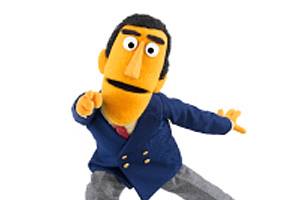
 There are very few days when I think of myself as a writer, as an artist, or a creator. As I said in this really pleasurable discussion about creativity on Marshall Ramsey’s radio show, “Now You’re Talking,” fifty hours a week I am, joyfully and willingly, the Bob Barker of Scholarly Publishing. I am Guy Smiley. I am the marketing director at University Press of Mississippi, and I gladly do all I can to insure that the work of our authors makes it into the hands of readers worldwide.
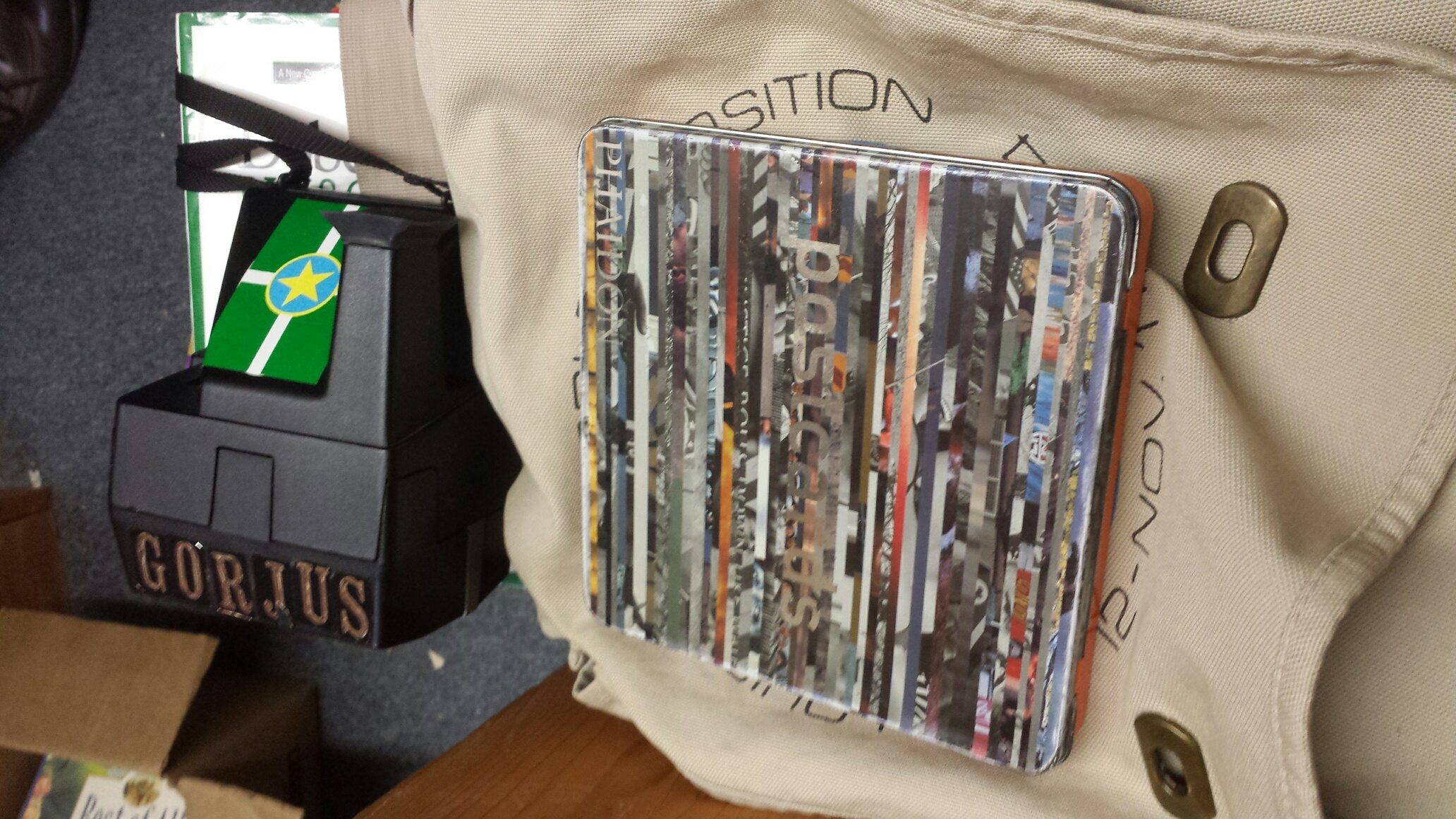
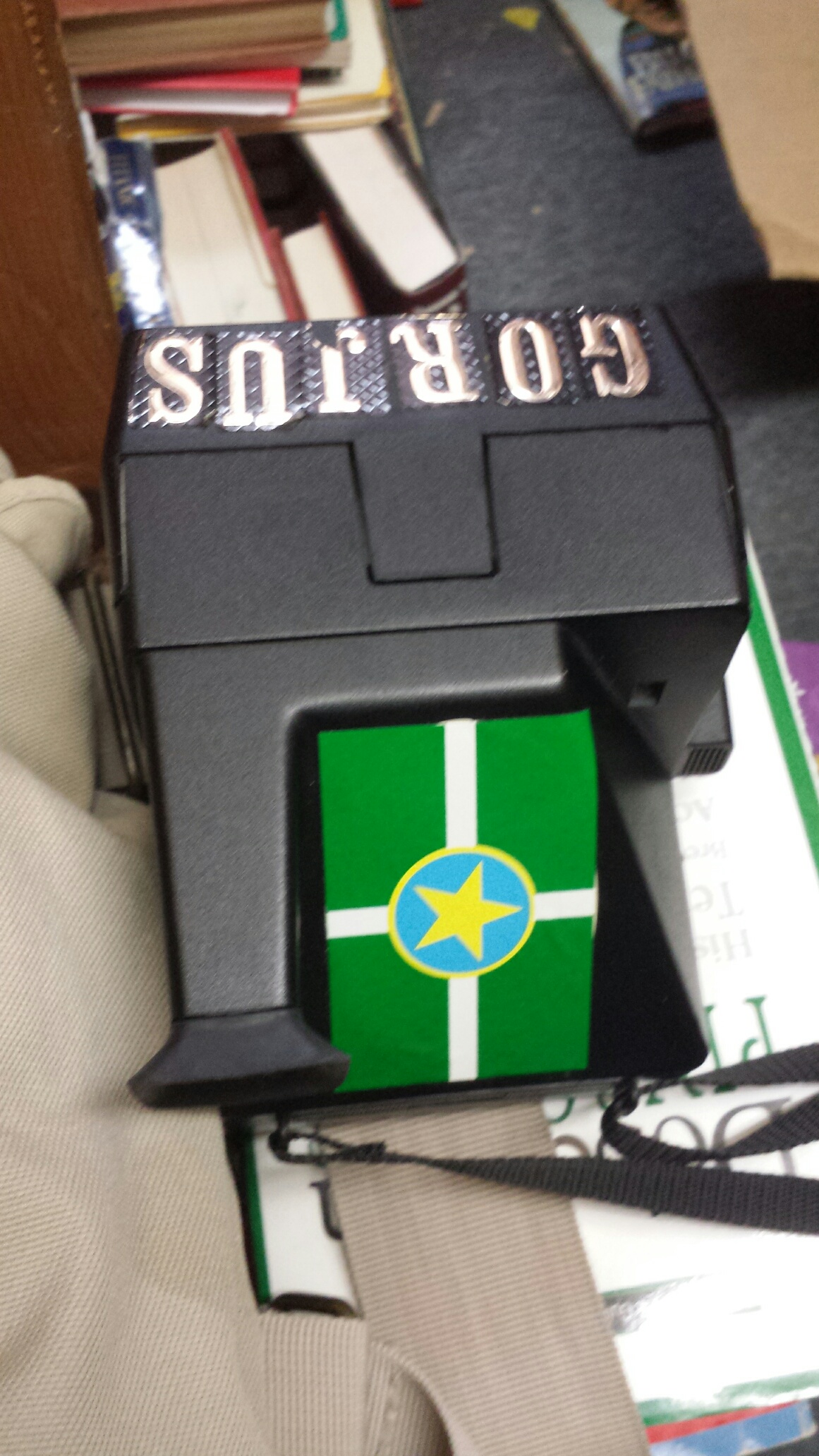
David McCarty is a Jackson lawyer in most of the daylight hours. When he can be, he is an art photographer, and his specialty is the use of old instant technology, specifically the Polaroid camera. His photographs have been exhibited at the Ogden Museum of Southern Art, and many other places.
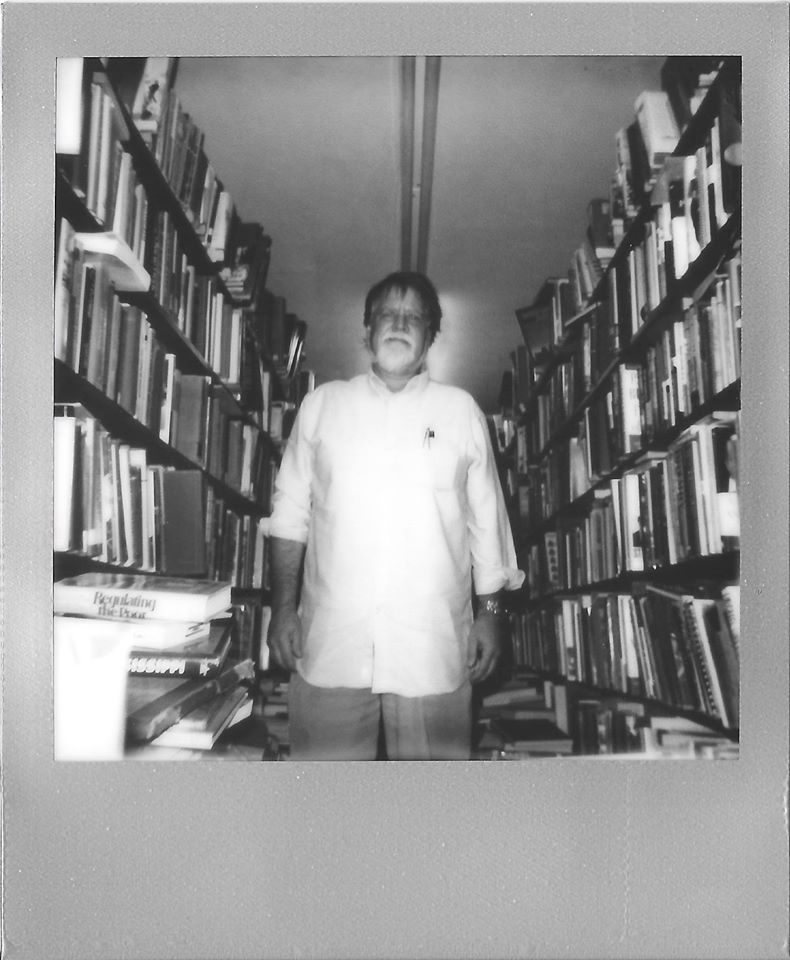
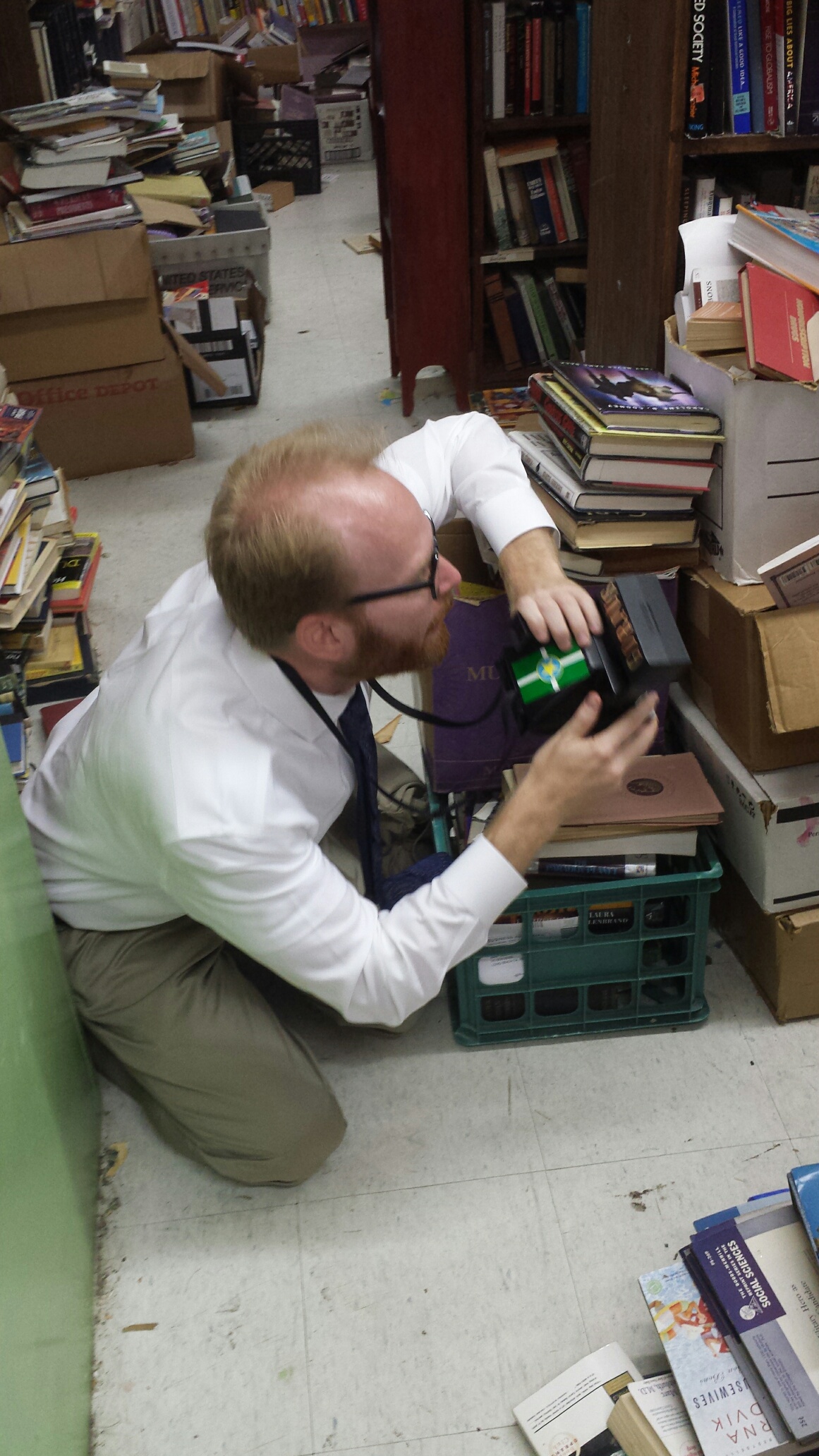
When he discovered Some Kinds of Love: Stories, he began to pester me with a persistence that would make him a fine university press publicist. David wanted to take a photograph of me, a set piece at famed Choctaw Books in Jackson. After much scheduling difficulty for almost nine months of trying, we found a day in July when we both could be away from work. That day, David took what may be the greatest photo that will ever be taken of Choctaw Books owner Fred Smith. Look how the owner of the most famous used book store in Jackson, Mississippi, appears like a shaman in this Polaroid!
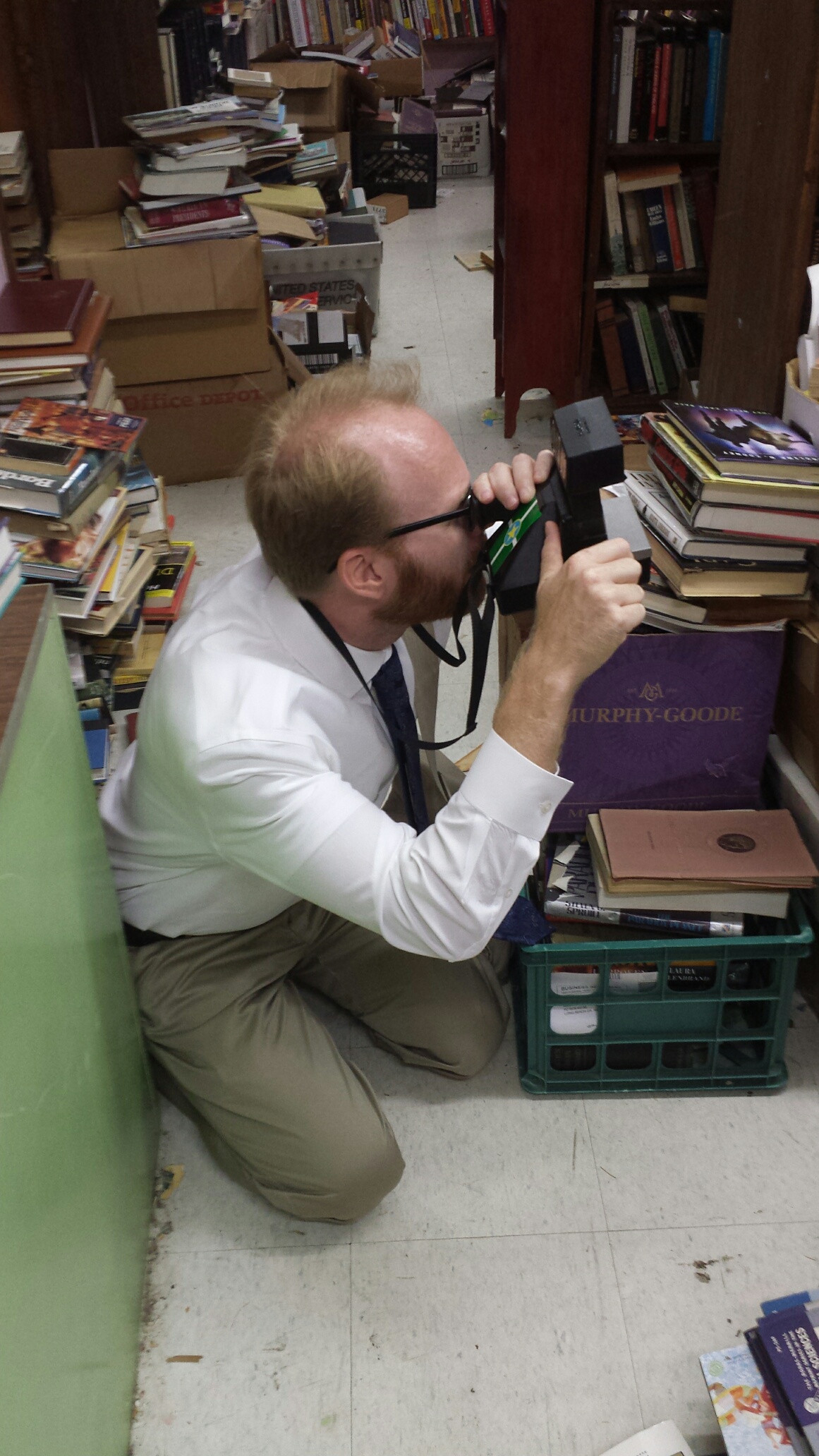
And, unlike any photographer I had previously been around, David did not mind at all that I wished to snap photographs of him working. I was taking leave time to do this (one year ago, according to David’s records). Somehow, when we arrived at Choctaw Books, we exited the real workaday world and entered a solar system entirely of David’s making. In the looming stacks, I followed David’s lead and gave myself to his sway—it was crazy, ridiculous to think that I was a writer worthy of an art photographer’s time. But I could tell as I watched him and photographed him, David McCarty was very serious about this. He thought I was a subject of which art could be made.
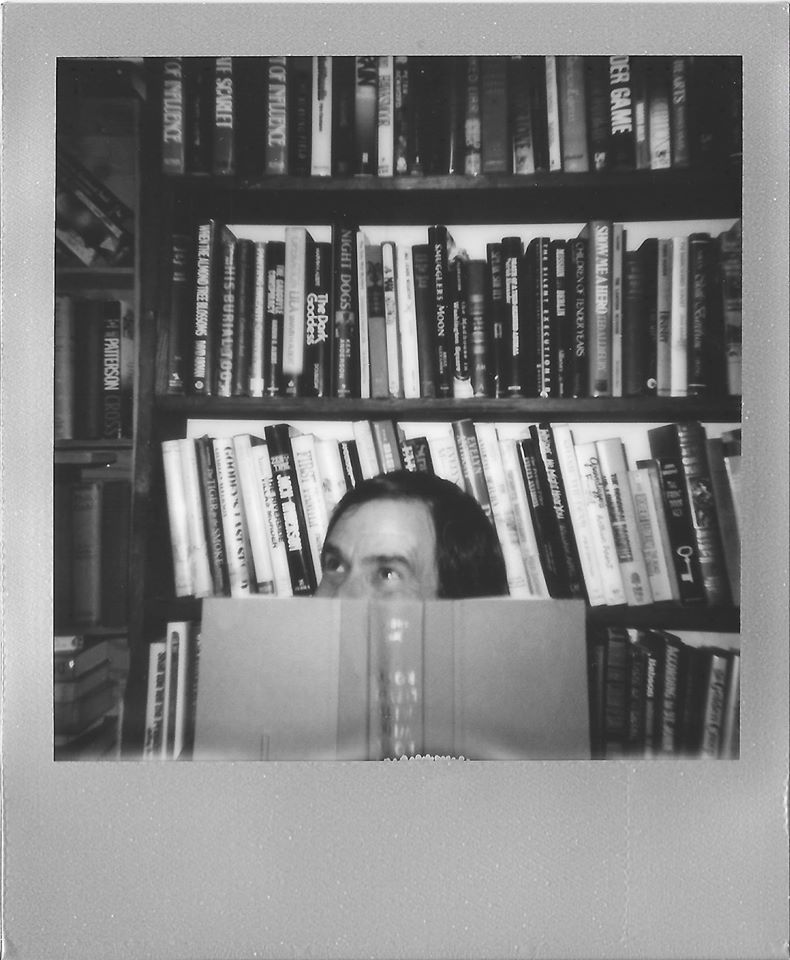
The result, since we are talking the semi-instant Polaroid, was astonishing. With no guidance from me—I hardly knew David, and we were both so busy we had no time to talk about what he wanted to do—I think he did capture, as only art can, the essence of another’s spirit and truth. He wanted me swallowed in books; he didn’t know I would be smiling like an imp. And he didn’t know how charmed Fred and I would be by the whole fiasco of an art photography shoot happening in the explosive clutter of Choctaw Books on a broiling summer day.
I was so swept away by the zaniness of the day, I had to share with David a song from “Riba Dimpel” an album one of our authors, Jan Brokken, The Music of the Netherlands Antilles, had shared with UPM for our inspiration and understanding. The song was “Cara Bunita” by Estrellas de Caribe. David brainily explained the song’s refrain, “arte foto, foto arte,” may have referred to the 1920s euphemism for photography of naked women, an “art photo.” So the drunken joy of the band may have had as its theme an “angel in the centerfold,” very roughly translated.
We had lunch at Rainbow Coop in Jackson, a place I hardly ever go to because I am a boring, cheap Biedermeier who eats leftovers at his standing desk. And so, with the lunch crowd mostly departed, the corona of strangeness, of artiness ignited at Choctaw continued.
Somehow over the long meal, we moved to a broader subject, The Golden Age. We had talked of September 11, Hurricane Katrina, The Great Recession (which at the time we were not sure was quite over). These so far were the marks of our twenty-first century. But we also talked of Mississippi changing, of the American Civil Liberties Union being tolerated with an actual office space, the state flag almost changing, Ed King’s new book about to be published. There were sunbursts of intense hope. I believe that is what got us onto The Golden Age.
When would it be? What would be its markers? What could we then achieve if we recognized them? And what could we do to keep a Golden Age from sliding quickly into a Gilded Age? Heady stuff we covered, and mostly without irony or farce, which is saying a lot for me about how earnest, how penetrating our talk was. Normally I cannot tolerate such talk with a straight face, any more than I might feel comfortable talking about creativity for an hour (which despite what it may sound like in the interview linked to above, I wasn’t all that comfortable talking about).
Today, a year separated from that starburst of a morning and afternoon with David, I was reading the great Stefan Zweig’s The World of Yesterday. At lunch with David, I had come to the conclusion, and I do not remember if David agreed, that we would not, that we could not at our pace recognize the Golden Age as we were living it. I was firm in that I believed such an age would roar past the two of us, and as old men, we would look at each other and say, “Gee, that old La Salle ran great! Those were the days.”
Zweig’s memoir is more documentary in its beauty than literary. It is certainly not Nabokov’s Speak, Memory. There are many moment’s in which Zweig is an irreplaceable witness to late Habsburg Austria-Hungary and pre-World War I Europe. During the First World War, Zweig’s own humanity and urbanity in some ways interfere with his capacity to witness, but who can blame him a sorrowful disdain, a necessary great distance?
Then this morning, the passage that vaulted me back to my encounter with David, with art, with someone who could remind me of that parcel of myself that only occurs now, in the dark, wee hours, from 3:30 a.m. until 6 a.m. or so when I write, when I attempt to create. Zweig’s memoir is devastating in its revelation of Austrian life right after World War I, when a 700-year dynasty was deposed and dismantled, inflation went wild, even the lights could not be adequately powered.
Art is worth our all. Art will be the harbinger of that Golden Age and its lasting aftershock. I need to have lunch with David McCarty more than once a year. Behold, Stefan Zweig:
“I shall never forget what an opera performance meant in those days of direst need. For lack of coal the streets were only dimly lit and people had to grope their way through; gallery seats were paid for with a bundle of notes in such denominations as would once have been sufficient for a season’s subscription to the best box. The theater was not heated, thus the audience kept their overcoats on and huddled together, and how melancholy and gray this house was that used to
glitter with uniforms and costly gowns! There never was any certainty that the opera would last into the next week, what with the sinking value of money and the doubts about coal deliveries; the desperation seemed doubly great in this abode of luxury and imperial abundance. The Philharmonic players were like gray shadows in their shabby dress suits, undernourished and exhausted by many privations, and the audience, too, seemed to be ghosts in a theater which had become ghostly. Then, however, the conductor lifted his baton, the curtain parted and it was as glorious as ever. Every singer, every musician did his best, his utmost, for each had in mind that perhaps it might be his last time in this beloved house. And we strained and listened, receptive as never before, because perhaps it was really the last time. That was the spirit in which we lived, thousands of us, multitudes, giving forth to the limit of our capacity in those weeks and months and years, on the brink of destruction. Never have I experienced in a people and in myself so powerful a surge of life as at that period when our very existence and survival were at stake.”
 Fiction and History