 COLUMBIA, Missouri — July 18, 2015
2 – 4 p.m.
Join two authors with Missouri roots for readings from their latest projects, followed by a discussion on writing with topics ranging from choosing historical fiction to literary license and historical accuracy.
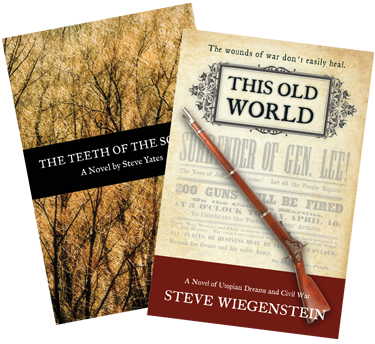
Steve Wiegenstein will read highlights from This Old World, which was recently announced as a finalist for the M. M. Bennetts Award for Historical Fiction. Set in the utopian town of Daybreak, the novel depicts a troubled community deeply changed by the American Civil War. As the characters write the next chapter of their story, the men and women struggle with leadership, lust, and their own flawed humanity. Steve Yates also explores the aftermath of the Civil War in The Teeth of the Souls, which tells the double life and love story of Leighton Shea Morkan. Leighton’s affection for his childhood confidante and former slave, Judith, endures despite his marriage to another woman. A sequel to Morkan’s Quarry, the novel follows Springfield through a triple lynching on Easter 1906.
THERE IS MUCH ABOUT THE ABOVE that I still find hard to believe. Around our house in Flowood, Mississippi, it takes very little searching on any book shelf to find a read and marked, dog-eared copy of The Missouri Historical Review.
In graduate school at the University of Arkansas MFA program, I read the magazine as faithfully as any literary journal. And, when I became publicist at University of Arkansas Press and had the privilege to work on books by Milton Rafferty, James Keefe, and Lynn Morrow, I read The Missouri Historical Review even more eagerly.
Fellow writers in the MFA program found this habit odd. I’m sure almost as odd, off-putting, and disconcerting as some historians found it that the publicist working on their books was a fiction writer publishing pretty regularly in The Missouri Review, Ontario Review, and elsewhere.
Before a conference at Jerry’s Diner, formerly on the corner of Dixon Street and 71B, I spent a really extraordinary hour-and-a-half waiting on writer and fellow MFA candidate Jay Prefontaine for breakfast and a story session. I was to comment on one of his fictions in draft, and he would do the same, critiquing one of mine. I sat there with coffee and grapefruit and read The Missouri Historical Review and watched all the farmers and locals come and jaw and go.
Ozarkers! My people! It was wonderful, that much normalcy right there in Fayetteville. In the narrow bandwidth that was the MFA program, all was cartoon land. Priorities that existed nowhere else in the known universe were, in the program, outsized urgencies: “Today I must craft a sestina! The Chariton Review has rejected me yet again!” But here in Jerry’s, the Ozarks resumed like a calm back bay’s water spreading against a rollicking beach of irrepressible hedonism. A big, sunny spring morning outside boomed through the windows, so that the diner became a kind of corona of formica and vinyl, ball caps and bacon grease.

Jay pulls The Missouri Historical Review from my hands, reads the cover, flips it around, hands it back, sits down. “We’re really different, aren’t we, Stevie.”
“Yes,” I say. “You, for example, are ninety minutes late. Coffee?”
“Why read that?” he asks squinting at it again.
I think a minute. “Inspiration. There is a story waiting untold in every paragraph.”
Pause. Some squinting around at the calm glory that was Jerry’s. “We’re really different, Stevie.”
On July 18, I will be permitted the chance to walk through the doors where The Missouri Historical Review is edited and published, permitted to stand on my hind legs alongside a writer I tremendously admire—Tall Steve Wiegenstein—and then permitted to dare a crowd in Columbia, Missouri, to take my fiction, based on and inspired by history, seriously.
No one is more surprised than I am.
 Fiction and History