 Why are the villains often so much more fun to write and so much more enjoyable to read about than our angels?
Consider John Milton’s dilemma—the most exciting parts of his great epic poem, Paradise Lost, all involve Satan, the Fallen Angel. Look at Mark Twain’s Adventures of Huckleberry Finn. When the Duke of Bilgewater and the Late Dauphin board the raft, we are almost midway through the novel (Chapter 19) and in dire need of some villainous chicanery.
The crime writer might say we thirst for justice, this after delivering chapters on chapters of delicious, glamorous evil. Now in the best of the noir genre, even the good guys, the protagonists of the stories are flawed and capable of making ruinous decisions and wreaking much havoc on those they should love and protect. How many times reading the great Daniel Woodrell’s Tomato Red do you say to yourself, “Sammy, no! This is a terrible idea!”
Maybe as writers we circle those questions that William Blake threw down so unforgettably in “The Tyger.”
Tyger, Tyger burning bright
In the forests of the night,
What immortal hand or eye
Could frame thy fearful symmetry?
The writer constructs a world, and the conventional reader hopes in that world the heroes will prevail, justice will be done, and the outcomes will be universally good. But then a world perfectly constructed does not at all mirror the world we know, and, maybe worse, a perfectly constructed world does not hold our interest. We want to circle the tiger. We want to know why she is there, and we want to understand how she can be so beautiful.
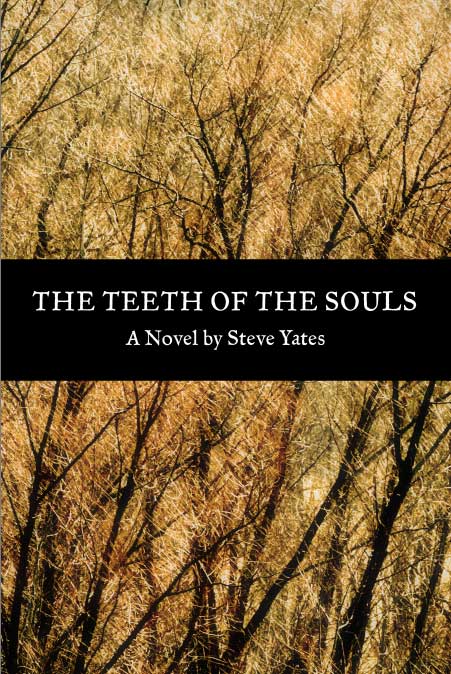
I have a critic and reader in my hometown, one I am beginning to trust above all others. (And add this to the almost impossible miracle of being able to say “I have a reader”—this reader is not another writer from an MFA program, but an actual reader of fiction by choice and for pleasure!) He was kind enough to read an early draft of The Teeth of the Souls due out from Moon City Press in March 2015. I was both frightened and pleased at once to hear my reader’s comment, “There’s no doubt about your bad guy in this one.”
 That inspired me to make absolutely sure I knew my bad guy and write him more clearly. Once after enduring a really boring presentation made to a group of new state employees in Arkansas, I couldn’t help myself and asked the auditor and presenter what kept him coming to work each day. From what the auditor had said so far, I thought his lot in life crushingly, mortally dull. He smiled and eyed first me, and then the rest of us blushing new state employees with a palpable, joyous suspicion. “It never ceases to amaze me,” he said slowly, “how I can set up a series of safety checks, accountings the employee has to file, and then some criminal, creative someone will find a new, incredible way to outsmart me. Something I would never think to do with money and property. They outsmart me. They get away with it.” He paused and watched us all. “But only for a little while.”
I had to circle the villain one more time and ask all the old accounting questions again. This is the opening to the final section of chapters called “Easter 1906.”
- Book IV, Chapter 1
All around Springfield and Moon City, in buildings Archer Newman designed and built, he left himself a cubby, a flop, or a loft, and stayed silent on this deviation from printed plans. He trusted and used only three contractors, all matriculated as lads from the last days of masked riding, and they hung on Archer’s every word and vested his secrets like acolytes before Nikola Tesla. Buried in the real estate contract, the codicils describing dimensions, access, and ownership of these niches were sometimes overlooked by faraway or careless landlords. Careful readers of abstracts, usually hired attorneys, called these to attention, crossing out the strange descriptions and initialing alongside, or circling and flagging with a waxed sliver of ribbon. Then the transactions languished until buyers’ representatives could corner him. He smiled and said blandly, “Another purchaser can be found.” Never did he telegraph, write, or telephone so that outside the abstract—eventually tucked away in the courthouse, which like so many in the Ozarks might any day burn to cinders—no other written record of these spaces came to light. On the surface, it would seem easier for him to retain ownership of a building and do as he pleased with all its square footage. But then others might readily find him and he might be held responsible to someone! In this way Archer Newman retained many options of ducking complications or making liaisons on the quiet, such as today’s with the rowdy agitator, the blacksmith Doss Galbraith, who hated the Negro and held many potentially useful opinions.
Archer waited in one of his favorite of these nooks, in a foreclosed building between Moon City and Springfield, The Chesapeake it was called, one of the owner’s many follies. The confusing, irrefutable, and infungible presence of Archer’s anomalous walk up on the far northeast corner of the four story brick building ground a bank sale of the property to a halt. When the bank failed soon after, the Chesapeake became just one more empty shell following the 1901 panic.
His favorite smell, as it preceded a system in collapse—the agitated, cordite-like unseen fire of blocked rotors humming in a St. Louis electric motor. At the Chesapeake, Archer kept a veritable museum of electric engines, specimens ranging back to Farraday’s Mercury Rotator, Double Barlow Wheels, a Sturgeon’s Interrupter, and forward to Tesla’s Coil and Edison’s Rotors. On oak work tables the zinc electrodes, copper coils, rotators, stators, and commutators ensnared one another in hedgerows of experimental brush.
His favorite sound—the low moan of the wind caused by a window not properly framed, never completely to be shut. Winter wind circulated furiously against an ell he created in the Chesapeake. His favorite sound because when the North wind hit at anything above ten miles per hour, that skewed window moaned like Aureole the night he first discovered her. A whore in Providence. Some sailor had beaten her unconscious. Archer watched the assault from a closet where he had crawled in to sleep off the brothel’s dreadful gin. With scientific detachment, he witnessed the Briton gag then pound her and stumble away. Fascinated—this would be the first human he witnessed in the act of dying—he observed her rib cage rise and fall and then diminish. Such a waste, she bore high, round cheekbones, a doll-like face, tremendous breasts, and now she would die. A pity. But after an hour of insensibility, she used both palms to push herself off the hard-swept puncheons. Scanning around with wet, brown eyes, she realized she was not in Heaven, not dead. And, naked and beaten, seeing where life had at last taken her, she made the terrible low, winter moan coming from the window now.
His favorite sight—out the window near Fassnight Creek clung a forest copse on undeveloped land that still retained the wild look of the Ozarks woods. And, even now in winter, staring deep into the tangle of oak and hickory and cedar and poison ivy and sumac and creeper to the shadowed point that from chaos truly formed the wode brought his mind’s eye closer and closer to that moment of blank, black void where there was no one and nothing but only his own mighty, whirling, vicious conceptions.
In every of his secreted cubbies across Springfield, he kept two trunks beneath the panels of the floor or resting upon deal wood nailed between rafters in the attics. In each trunk two locked compartments. In the compartment oriented northeast, patents of which he proudly held several, other pending or failed patent applications, journals, sketches, drawings, and plans. In the compartment facing southeast, a duplicate set to the undiscerning eye, but, upon close inspection, falsehoods, flaws, fatal turns, mercury added befouling formulas.
His least favorite sight now came into the window that looked out on Fassnight. He reached to turn down and then extinguish the lamp. Leighton Shea and Gustasson Morkan strolled West Grand in clear, exultant communion, the father guiding the son in some matter, the son absorbing, relating back, and delighting Archer’s aging rival. In the dark of his warren, Archer brooded on their promenade—were they meeting with Phenix Lime and colluding; where were they strolling? How had fate dealt him three unmarried daughters that floated like swollen airships from room to room, from bakery to café to dinner club to church then weeping to the confectionary with no callers or prospects? He had, after all, rescued a whore from sure death and an unmarked grave! O, to grip a son’s shoulder with that exuberance and point to some future that was his, that was theirs together, the power of the gesture mightier than a standing wave in the lee of a mountain! And not just one son, but two, the secret son Archer knew in the Negro Holofernes Lovell. Bundled like a deadhead against the chill of the otherwise abandoned Chesapeake, he did not register the St. Louis motor’s final kick at the screwdriver he had jammed in it. And in the ascent of the Morkans along Grand, he could not relish the rise of smoke and valence from the cataclysm he had made of a perfectly sound little system.
When he heard boots scraping the stairs, he wondered how often Doss Galbraith had thought of Leighton Shea Morkan, who loved the Negro race so well.
 Fiction and History