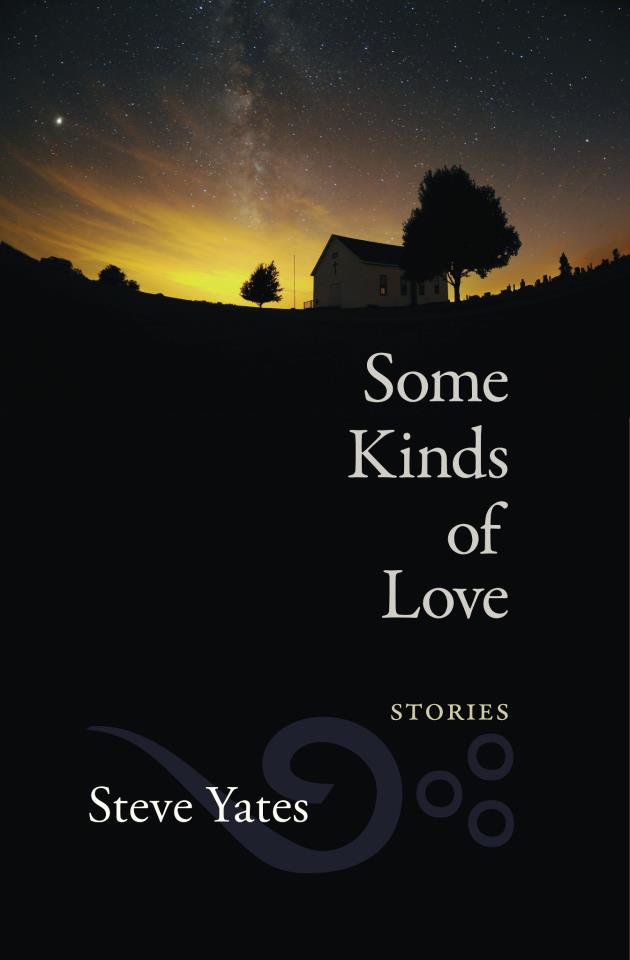
Q & A with Steve Yates author of
Some Kinds of Love: Stories (University of Massachusetts Press)
Steve Yates won the 2012 Juniper Prize for fiction, established in 2004 by the University of Massachusetts Press in collaboration with the UMass Amherst MFA Program for Poets and Writers, presented annually for an outstanding work of literary fiction. His collection, Some Kinds of Love: Stories, will be published by University of Massachusetts Press in April 2013. Sabina Murray, author of The Caprices and Tales of the New World among others, was the judge. The dozen fictions in Some Kinds of Love: Stories were all published in nationally renowned literary magazines such as the Missouri Review, Southwest Review, and TriQuarterly. One was honored by Richard Russo and the editors of Best American Short Stories 2010 as among the 100 Distinguished Stories of 2009. Another story was nominated for the Pushcart Prize. Yates earned his MFA in writing from University of Arkansas. His first novel, Morkan’s Quarry, was published by Moon City Press in 2010. Yates joined the University Press of Mississippi in 1998, and is now assistant director / marketing director at the Press in Jackson, and lives in Flowood with his wife, Tammy.
Q: So Some Kinds of Love: Stories is a short story collection. It’s not the sequel to Morkan’s Quarry?
A: Right, these are twelve stories I wrote and published between 1990 and 2012. But, one of the stories, published originally in the Missouri Review, is really an adapted version of chapter two from the sequel to Morkan’s Quarry. So for any reader demanding to be back in the 1860s in Missouri with the Morkans, Some Kinds of Love: Stories has a taste of what’s to come.
Q: How many of the stories are about Mississippi?
A: The four longest stories are all set in Mississippi. Two in Jackson, one in West Point, and one, the longest, in Port Gibson. The other story set in the South happens in New Orleans.
Q: You’re from Missouri and have been in Mississippi now 15 years.
A: And before that in the Arkansas Ozarks for eight years.
Q: So do you think of yourself as a southern writer?
A: No way I can claim any of that great legacy. The Ozarks is not the South, and it’s not the Midwest. It’s the Ozarks, a border band of hills and mountains, and really the vanguard, Westernmost outpost of the American hillbilly. After Sallisaw, Oklahoma, and Joplin, Missouri, the continent flattens out, dries up, and becomes the West. The Ozarks is its own thing.
Q: Is there any such thing as an Ozarks writer?
A: Maybe. Donald Harington, Daniel Woodrell, Skip Hays, Speer Morgan, Paulette Jiles all come to mind. All of them are as wonderfully different as stars in the sky. So it’s not hard for me to conceive of an Ozarks writer and an Ozarks literature, but maybe it would be hard to categorize and teach an Ozarks literature. And of course most outsiders would sneer that “Ozarks literature” is an oxymoron, like “luxuriant outhouse.”
Q: When you write about Mississippi, did you feel a bar raised there? I mean, it’s not like Mississippi needs another fiction writer with Faulkner, Welty, Wright, Morris, Hannah, Nordan, Yarbrough, Watson, and now Jesmyn Ward from the Coast.
A: And a lot more besides them, too. I thought about that some, but in the end I figured here I am watching people work and love and fight and make fools of themselves and reconcile and raise kids. If a story hits me, let the literary journals sort out whether what I’m writing is worthy. And they did. All four Mississippi stories found publication, and one was even named among the 100 distinguished stories of the year by the editors of Best American Short Stories. I can’t really help where my job is. And I would also say that for a place that already has plenty of writers, Mississippi is incredibly welcoming to anyone writing. Outside of a graduate school writing program, I’ve never lived anywhere like it. With almost no prompting, people will openly tell you that they are writing and tell you what they are writing. Growing up, I would no more tell someone back home that I was a writer and what I was writing than I would try to sell them a UFO detector and a foil cap.
Q: You use a lot of humor in your stories. I mean, one is about a teenager who thinks he’s a performance artist and throws his family’s pigs over retail counters in West Point, Mississippi. Do you worry that Mississippians won’t care for an outsider making jokes?
A: For that story, I’ll risk some ire. The seed of that story was in the news of the weird—that associated press news feature that used to run on the wire service. A kiddo in West Point, Mississippi, had actually done that, driven around in the pit of night and hurled pigs across retail counters. In the Ozarks that would fit right in. He could have been from Buffalo or Marshfield or Sparta. Mississippians I work with were mortified that the nation, for one slow news day in December, was sharing that story far and wide. I proclaimed that the young man was a performance artist with a message heaved right at the heart of corporate America. There was considerable skepticism among my colleagues, but I couldn’t let it go.
Q: So some bored country kid throwing pigs inspired you?
A: A great performance artist! And I don’t believe in inspiration. Only obsession. I work fifty hours a week at a great university press. I have plenty of intensely fulfilling work. There’s no reason on earth for me ever to write a short story. But when something is an inescapable obsession, there’s really no stopping.
Q: Work does figure in a lot of these stories. None of your stories are about a struggling writer, or a student, or someone without a profession.
A: I do tend to write about people who are employed and whose worldviews are shot through with perceptions gained at work. One of the oddest things for me about contemporary American writing that tries to be literary fiction is this: people seem to have no discernible means of economic support in short story after short story, novel after novel. No jobs. Magic trust-fund babies do Portland! Whee! Americans are intensely defined by the work we do; few national workforces in industrialized countries work harder and longer and yet go back for more and say they love it.
Q: So that’s where we get the list on the back of the book—pioneers, limestone quarry owners, nurses, sex toy catalog designers, attorneys, missile guidance masterminds, librarians, highway engineers?
A: From age eleven I had a paying job, whether I was a gofer at Yates, Mauck, Robinett, and Bohrer, or at sixteen, a sportswriter for the Springfield News-Leader, I was doing something for a wage, and had big, black rings under my eyes. Even in graduate school in Fayetteville when there were no teaching slots, I surveyed highways in the summers and did construction inspection. Work matters to American life, and certainly to the Ozarks I know. I don’t think I could write a story about someone without a job. I mean, even Mrs. Bridge was affected by a job and really had a job, right? She was the wife of attorney, Mr. Bridge, and mother of three. She ran a household in Kansas City, and her leisure hours confounded her.
Q: Okay, that’s a lot about work, but the story collection is called Some Kinds of Love. What about love?
A: Well, the book is dedicated to my wife, Tamara Gebhart Yates, also of Springfield, for a lot of reasons. For a major inspirational reason in that she was the one who dared me to write a happy ending. Why in undergraduate school at Missouri State and graduate school at University of Arkansas in the late 1980s, early 1990s were we writing all these stark stories with fatalistic, inconclusive endings? Tammy hated that vogue and dared me point blank to think outside of it. And it ended up that each of these characters I invented found their struggle was with some aspect of love, how love did not work the way they demanded it to or the way venial desires led them to believe it did.
Q: So does everybody end up happy, happy, sunsets and holding hands? Who is this book for?
A: No, I can’t conceive that Hollywood, Disney outlook. Love is work sure as life is work. And I keep fretting that people won’t recognize that some books are for adults only. This book is called Some Kinds of Love, so people in the book will tear their clothes off and do terrible things to each other as surely as they may undress and do loving or merciful things that are nonetheless adult in content. My wife will sometimes ask when I fret about this, “People realize you’re not writing Hallmark cards, right?” Watching the public at my own book signings for Morkan’s Quarry and at book signings for University Press of Mississippi, my employer, I don’t know what people recognize any more. I think they are too busy sometimes, and find themselves somewhere with their kids, who may already have seen way more violence and depravity in movies and on television than I ever want to stomach.
Q: So the other stories set in the South, what are they about?
A: They are about all kinds of people—a terrorist cell member and a librarian who fall in love; three gay men in a love triangle, one of whom is stealing; a lawyer in Port Gibson who is losing his daughter and his town; a catalog designer for a company that sells sex toys.
Q: Sex toys?
A: Someone has to design those catalogs! The story is set in New Orleans. I wrote most of it one night while manning a book exhibit in New Orleans. I feel as if I’ve been in that city as often as I have been in New York for my work, and that’s a lot. From my hotel room, I could see people working, some pretty late, in a white, stone building on Saint Charles called The United Fruit Company Building. What are they doing, I wondered, working so hard and so late in a city that offers such a riot of dissipation and distraction? And they looked happy, too. It was office work, with PCs and Macs and modems blinking. They weren’t wistfully gandering at the street or rolling their eyes at the clock. And here I was, passing up a night’s frolic in the only foreign, carnival city in America to write all night until the last street car boomed home. And loving it.
Q: What does the title, Some Kinds of Love: Stories, mean? What’s it from?
A: Only a book geek would come up with a dream like this. As soon as I conceived of the title, since again and again love seemed to be what I was writing about, I realized something in Dewey decimal destiny might happen. There is a great short story collection, which all of us in creative writing programs have read and learned from, a classic. Now that University of Massachusetts Press has published this, there exists the distinct Dewey-decimal-system possibility that in some library where fiction is shelved the spines in a row will read Richard Yates: Eleven Kinds of Loneliness, and then a humble answer, Steve Yates: Some Kinds of Love. As a kid I was left alone for hours and hours on end at the Brentwood Library back home. It had a pronounced effect on me.
 Fiction and History