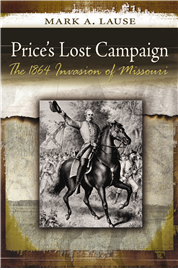
1864 raid into Missouri rightly remains a brutal enigma in Mark Lause’s Price’s Lost Campaign: The 1864 Invasion of Missouri
Even as General Sterling Price’s fall 1864 campaign deep into Missouri proceeded, its participants and victims shifted their conception of it so rapidly as to push the fog of war into a realm of nightmarish unreality.
Call it a raid. Call it a failed invasion. Call it a colossal failure. After reading Mark A. Lause’s new book Price’s Lost Campaign: The 1864 Invasion of Missouri, I doubt that any but the most calcified Lost Causers will call this incursion of 12,000 Confederates into what had been conquered, occupied, if not pacified Union Missouri a “high water mark.”
This book, somewhat unfortunately and a little mysteriously, only follows the history of Price’s running disaster from the emergence of Price’s vast army at the southern border to the shrug at the capitol of Jefferson City along the Missouri river, where that army turned away in the face of a fictional number of soldiers entrenched before it and a phantom army thought to be closing in behind it. It may well be that the editors at University of Missouri Press asked for a shorter book. But knowing the campaign, I was surprised the narrative did not carry on further and end at the Battle of Westport, one of the Civil War’s largest cavalry engagements, and the moment I had always imagined everyone in Price’s army had to have realized all was for naught, the cause was lost.
But that may be another fiction Lause wishes to pierce. General Price, hero of Wilson’s Creek and Lexington, and the focal point of Missouri’s Confederacy, had already made major revisions in his own mind about what was the goal of this huge, ill-fated action. At Pilot Knob, he gave up nearly a whole week’s initiative and surprise. At Pacific and Union, he realized he really could not take Saint Louis. And then at Jefferson City, he gave up everything but his army’s survival. County by county, as his Missouri State Guard reached home territories, his army evaporated.
There is a running clash of fictions from both sides throughout the book. After a long list of Price’s dodges and fabrications, Lause says “These self-serving fictions became history because they jibed nicely with those of Union commanders. Where Price had sought to cover bad decisions, Rosecrans (Union commander of the Missouri theater) needed to obscure the fact he had made so few.”
Not dodged, and stated here in frightening, sorrowful terms are the attrocities committed by Price’s army. Despite the seeming gentility of many of its commanders, this Confederate army unleashed savagery on Unionist civilians, their homes, their property. Especially brutalized and murdered were Germans and African Americans. Lause further brings to the fore the pluck and fortitude of enrolled militiamen on the Union side. Many of the real battles fought in this campaign (there is an entirely fictional Battle of Linn made up by Jo Shelby’s secretary!) were fought between local Union citizenry alongside enrolled militiamen and hardened Confederate veterans alongside their cold-blooded guerilla allies.
I have great admiration for Mark A. Lause for teasing apart all these twists of truth while exposing the motivations for creating such fictions. His prose is on the whole distinct, and approachable, and especially lucid and careful when his subjects are trying not to be. Commanders on both sides, Lause finds, compounded the fog of war with so much posturing, fear, and pomp. Union commanders fearful of committing real troops in a major engagement, thus facing a possible defeat, allowed Price to rampage. And all along its course, the wake of death and destruction following Price’s nearly out-of-control army rivals anything any other Confederate army unleashed. Why lie? Read herein.
 Fiction and History