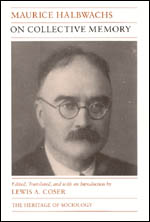
 Finishing Maurice Halbwachs’ On Collective Memory, I find some concepts that I want to roll around. My 1992 edition is a Lewis A. Coser translation from University of Chicago Press. I think a reading of this volume will be of great benefit to any writer who has written or is attempting to write books set in a time period not lived by the writer, works in which the past is either dreamed or recollected. If nothing else, Halbwachs has the sociologist’s and philosopher’s capacity to describe social systems so succinctly, his prose can reawaken us, help us understand why we do what we do, why we accept what we accept, why we defend both the indefensible and what we cherish.
What in On Collective Memory might help distinguish between the literary novel and the historical novel? Halbwach’s says in his opening chapter, Dreams and Memory Images, “The dream is based only upon itself, whereas our recollections depend on those of all our fellows, and on the great frameworks of the memory of society.” Recalling how many times good fiction is referred to as a seamless dream, I like better my mistaken paraphrase, “the dream depends only upon itself.” The literary novel—set in the past and written about middling characters, ordinary people—operates much like Halbwachs’ statement about dreams. The work of epic historical fiction—set in the past, but written about renowned historical characters—operates under frameworks often like those Halbwachs’ assigns to recollections. Much other historical fiction such as military, or historical romance (see definitions) operates within more rigidly accepted frameworks and operates like recollection as well.
What is epic historical fiction? Let’s distinguish between it and the literary novel set in the past. An epic historical novel is one in which all main characters are outsized, Achilles-scale, major players of history, as Georg Lukács calls them “world historical figures.” Most often there is no reader’s ambassador here, no single protagonist to focus upon. Our narrator can range from the sweep of continents to the creases beside Robert E. Lee’s tired eyes. Historical accuracy is lifeblood, the course of the narrative follows history closely, and closely adheres to the social frameworks of our expectations, of established judgment on the great men of history. The purpose is to give some feeling and emotional flicker to the actions of the great makers of history while at the same time affirming legend held dear in a people’s collective memory. Especially for an American market that hungers for nonfiction learning and strongly prefers prose to poetry, these creations seem attempts at national epics. See Michael Shaara’s Killer Angels, and any of the franchise of Civil War novels by his son, and even historical novels about Gettysburg by Newt Gingrich.
The dream is based only upon itself… How often we are warned as writers against breaking the seamless dream, and that breaking it forces the reader outside of the intense and pleasurable immersion that is great literary fiction! In its opening paragraph or paragraphs, great literary fiction establishes a mutually accepted and understood universe, the parameters and limits of the dream let’s say. And these contracts, if accepted by the reader and fulfilled by the writer, are integral to the dream that depends only upon itself. What do I mean by contract? Take the first paragraph of Stephen Crane’s The Red Badge of Courage. Remember that great literary work and all it accomplishes and encompasses as a seamless dream. Then consider the contract and parameters established in its exemplary first paragraph:
“The cold passed reluctantly from the earth, and the retiring fogs revealed an army stretched out on the hills, resting. As the landscape changed from brown to green, the army awakened, and began to tremble with eagerness at the noise of rumors. It cast its eyes upon the roads, which were growing from long troughs of liquid mud to proper thoroughfares. A river, amber-tinted in the shadow of its banks, purled at the army’s feet; and at night, when the stream had become of a sorrowful blackness, one could see across it the red, eyelike gleam of hostile camp-fires set in the low brows of distant hills.”—Crane, Stephen (2009-10-04). The Red Badge of Courage (Kindle Locations 18-20). Public Domain Books. Kindle Edition.
This first paragraph establishes the omniscience of the narrator, the narrator’s third person relationship to the story, the pace of revelation, the naturalistic stance and distance, and the naturalistic view of a human collective (the army) as an organism with many eyes, and the enemy’s eyelike fires gleaming back. Crane sets out his twin themes: the opposition of the human enemy and the indifference and sometimes seemingly cruel atemporal beauty of the natural world. 107 words… even the word choice, tremble, shows Crane’s mastery of contract. We comprehend and accept the limits of the dream we are about to enter, and in 107 words we have a road map and a promise.
In considering the many and various forms of the historical novel, I can’t help but think that the literary novel (almost by its nature set in the past) is more dreamlike than say a novel by Michael or Jeff Shaara. In Killer Angels, the details the author arranges depend more completely on those recollections “of all our fellows, and on the great frameworks of the memory of society,” as Halbwach’s says. In an epic historical novel one cannot write much outside of what we hold in our collective memory on the idea (the image and arrangement in Halbwachs) of Robert E. Lee or James Longstreet, or whatever renowned historical figure the author of the epic historical novel animates.
In the literary novel, the dream depends only upon itself. There are intervening frameworks from society—the accepted forms of the novel, the contract with the reader, and the reader’s overall (and we hope not abused) willingness to suspend disbelief. But these frameworks are not so paramount as to intervene and even govern as Halbwachs argues in the way that societal frameworks do in human recollection. While coherence and arrangement of a recollection “belongs only to ourselves,” society and its frameworks (language, and/or good or bad or glad or sad and widely accepted judgments upon general actions and events and outcomes) intervene “to allow us to understand and call to mind this arrangement of objects that constitutes a complete picture or an event in its totality….” His argument that society collectively intervenes in any and all recollection is made nearly irrefutable when Halbwachs overlays the notion that our language in itself is a societal framework, one in which we agree on specific words and symbols to stand in for actual objects, emotions, states of mind, events, and so on. So critics can say, and in deconstruction they gleefully do say, that the author, being a product of middle class bourgeoisie society, can only pound out a defense of his or her socioeconomic class, because the mode of expression, language, the words of the novel, you see, are an inescapable societal construct. For the sake of retaining some joy and the hope of creativity among humankind, let’s move beyond that smug and not very helpful perspective.
The dream depends only upon itself. Halbwachs says “the frameworks of the dream have nothing in common with those of the waking state” and, “We should… renounce the idea that the past is in itself preserved within individual memories as if from these memories there had been gathered as many distinct proofs as there are individuals.” I don’t think I can entirely join him in these two absolutes. First “the frameworks of the dream have nothing in common with those of the waking state….” I’m not sure that is true in all cases, but then maybe I am a mundane dreamer. And, suffering powerfully troubling nightmares as a child, I learned to be a lucid dreamer, capable of changing or ending abruptly the narrative course of a dream, in essence writing my own dream or waking myself up from one gone awry. So the frameworks of a dream, for me at least, do have much to do with those of waking life. Even the childhood nightmare terrors of ghosts or aliens or criminals were certainly imported from if not governed by frameworks from waking life. And I would have to say the frameworks in the dream that is the novel very often have much to do with those governing our waking state and real life or historical recollections. Even such novels of magical realism as One Hundred Years of Solitude or The Architecture of the Arkansas Ozarks open with contracts that establish a framework and announce how the dream will proceed askance, in opposition to waking life and more conventionally realistic narratives. So maybe my metaphor of novel as dream that depends only upon itself is better stated as The dream depends mostly upon itself.
Second, Halbwachs insists “We should… renounce the idea that the past is in itself preserved within individual memories as if from these memories there had been gathered as many distinct proofs as there are individuals….” He says this about recollections, the opposite of dreams. As it has evolved the novel is in many ways an individual cry, a proof that there are “as many distinct proofs as there are individuals.” We find the universal in the particular, yes, but it is the uniquely detailed expression of that particular that makes a novel a work of lasting memory and literary value. War and Peace has many universal human truths throughout, but what stays in my memory? The uncle playing guitar, the niece, assumed to be too urbane for such, dancing an old Russian folk dance, the peasants stopping in their work to watch youthful, human beauty expressed, and the whole scene forever creating from particulars a quasi-universal empathy. I understood, in that moment of Natasha dancing and the uncle playing and the peasants beholding her, what it meant to be Russian and to be sincerely, authentically proud of being Russian. This from individual particulars I otherwise would never have had access to, particulars that lead to a kind of universal but specific national folk pride otherwise inaccessible to me.
Yet, like recollections and unlike dreams, the epic historical novel and many other historical novel forms operate not with distinct proofs from previously unknown individuals and their particular experiences, but from affirmation of widely accepted frameworks of our collective judgment on renowned figures experiencing a larger event. And of course, in a novel such as Killer Angels, an event, the Battle of Gettysburg, is treated with more importance than the individuals experiencing it, even those characters who believe they are affecting the course of the battle. This makes such a novel decidedly undreamlike in its purpose and composition. (And let me remind, in my post of the types of historical novels, I spoke of the importance of choosing what you want to write first. The same liberty exists for the reader. I do not mean to disparage, but I do mean to distinguish.) Halbwachs finds in dreams that one state of consciousness in which we can “understand and call to mind the images of objects (or of their qualities and details) in isolation, but which would not allow us to understand or call to mind the arrangement of images that correspond to a complete picture or event.” How very much like the modern literary novels of war! Consider The Red Badge of Courage , or All Quiet on the Western Front, or Isaac Babel’s The Red Cavalry Stories, or many of the short stories in Tim O’Brien’s great The Things They Carried. In these seamless dreams we do not, nor should we seek to, recollect and understand the complete picture or historical event. The individual soldiers do not and cannot have such perception, and it is their vessel of consciousness we rely upon. We do not choose these books to understand a battle or campaign or even a great leader. We choose them to understand the emotional truth of the human heart at conflict and in conflict.
Of course, War and Peace certainly transcends and blends both these genres, the literary novel filled with individuals, who cannot perceive the totality of the events, and arranged and narrated in a seamless dream, and the epic historical novel that overarches the individual, illuminates (or, for the snarky, decorates) the interiors of great leaders such as Napoleon and General Kutuzov. The reader can choose War and Peace to understand Russia’s travail and triumph or can choose War and Peace to understand what it was to live in those times, both functions of the epic historical novel. Or the reader can choose War and Peace to understand what it is to live, period, to be human, a function of the literary novel. And in framing the story with a question about the distribution of happiness and the fate of Pierre, a middling character about to succeed to nobility, Tolstoy arguably has what we have come to know as the literary novel in mind. Hooray for the great works that defy category and any and all thesis making!
So was I dreaming or recollecting in writing Morkan’s Quarry? Decidedly if somewhat lucidly, dreaming. Several times in the book characters express an inability to explain the war to one another honestly or with any real hope of understanding the totality of the American Civil War in the Ozarks. No, I had not yet read Halbwachs. This instinct though came from what I knew of the Civil War in the Ozarks, and in the ways we study it or skim over it with the phrase: “a place bitterly divided similar to many border states.” We study, unfortunately, all blue and gray, when the story in the Ozarks, to my mind, was really of a devoured and now forgotten middle ground.
A book very dear to me, in that I had a hand in promoting it as publicist at University of Arkansas Press, is The White River Chronicles of S.C. Turnbo. More than any other I think it gives voice to the Ozark civilian, those in the countryside who suffered years of fear and predation. Again and again in The White River Chronicles of S. C. Turnbo you will find beleaguered Ozarkers, regardless of pre-war sympathies, fleeing to Springfield, Missouri, after nightmarish, life-threatening visits from brigands of unknown allegiance. And you find many of the refugee men, then, joining local Federal militias, not out of conscience, but so as to have work and sustenance. Women at best labored hard to serve the armies here—diaries record countryside women toiling away to make flat cakes and baked goods to sell to Union soldiers even while guerilla brigands circled the city like vultures to rob the poor refugees of what they earned. Other diaries report unfortunates of both sexes wandering depraved and becoming alienados. Reason stayed long enough for them to flee the hills to Springfield. But they had seen brothers, sons, and fathers killed before them, and sisters and mothers tortured and beaten. In the seeming safety of Springfield, reason at last shattered and departed. Possibly a mercy considering what they had to remember.
Not knowing another’s allegiance and not being able to predict the behavior of those you encountered became a constant theme and a major cause of fear, flight, despair, and in some cases depravity and madness for civilians. Imagine you are in your yard carrying water from the spring house, your mother on the porch pounding dust from a throw rug, brother and father are one hill over cutting timber. Out of the mist come seven riders, all with Federal blue coats, but long hair, grimy faces, and when they approach you notice scalps trailing from their tack, holes in their tunics where a ball has passed that would have surely killed the man wearing it. What comes next?
Just the story titles in White River Chronicles of S.C. Turnbo are enough to understand—Hardships and Starvation in the Days of War; Saving Her House Through Tears and Prayer; Visiting the Grave of Her Affiance; Reading the Bible by the Reflection of Light from a Burning Town.
For those not in the middle, the progress of guerilla war and its uncertainties actually intensified one’s sympathies. So Union families became more vocally and even violently pro-Union. Secessionist families became more radically and, when necessary, more violently pro-rebellion. All of this devoured the middle ground. Why? We all want to live in predictable, and preferably non-threatening relationships with those around us, as Michael Fellman points out in his great book, Inside War: The Guerilla Conflict in Missouri During the American Civil War. Those who are unpredictable, whose loyalties and intentions and motivations remain unknown, are a greater source of anxiety than those whose actions and attitudes come from declared or discernible character and disposition.
This devouring and constant, violent uncertainty resulted in two psychological characteristics that Fellman points out in Inside War: 1) survival lying and 2) psychic numbness. Fellman found within the reams of testimony and diaries he digests that a great majority of Ozark civilians, regardless of their true sympathies, were not willing martyrs and stalwart heroes. To survive when under Union captivity or duress from guerillas, we lied. We were coerced into doing what irked our captors, forced by the other side, and had always been good and loyal whatever you need us to have been good and loyal to, sir.
Psychic numbness is quite possibly the most awful manifestation Fellman evokes. It is a state in which Missouri civilians, subjected to recurring, unpredictable violence from former neighbors and from both guerillas and undisciplined Union occupiers, unsure of the allegiances of others and finally even of their own allegiances, found life “emptied of any inner meaning,” found greed for money and food an overpowering instinct, and found violence to be the accepted and new norm of many social transactions.
I do think this period caused some serious creases in the Ozark character, and certainly in the way that we related to history and whether or not true recollections ought be aired. Reticence, distrust of outsiders, and that vanguard western desire to light out for the territory and be free of things civilized were all parts of our hillbilly psyche. Surely you can imagine how the war described by Fellman and Turnbo severely hardened hearts. Among those who experienced it firsthand, who would want to remember the real war on civilians or subject a child who had not seen it to tales of so much hate and destruction?
In fact, for those who experienced it firsthand, I think there was a willful silence and a determined forgetting about the war in the Ozarks. That’s why Morkan’s Quarry starts with the sentence: “When the war was finally won and the Morkans reclaimed their quarry after a fashion they did their best to forget the armies, the battles, and the occupations.”
Now imagine Ozarkers of that day sitting around listening to recollections of glorious battles fought elsewhere. That might be a short visit! Or it may be a welcome one, in that stories of towering heroes with clear allegiances, noble intentions, and unwavering honor might have been the history we longed for but never experienced. In the presence of a true war story, as Tim O’Brien says, a war story with “an uncompromising allegiance to obscenity and evil” one can see where Missourians and outsiders to the Ozarks would gladly take up the romantic story of the noble bushwhacker, a Robin Hood underdog fighting for a lost and chivalrous South that never really existed here. To understand what inspired me to write Morkan’s Quarry and to make it a dream, an attempt at a literary novel rather than an epic historical novel about renowned leaders of the blue and gray, I’m going to leave you with a true war story from the White River Chronicles of S. C. Turnbo. and then add my own projection as a sample process. Mrs. Baker and her fight are Turnbo’s recording in The White River Chronicles of S.C. Turnbo. The aftermath is mine. And warning, this isn’t going to be easy, but then dreams are not easy all the time.
“One night while Mr. Baker and Jim was away from home, the band of heartless men rode up to the yard gate and dismounted and walked into the house and with threats and oaths they attempted to compel Mrs. Baker and Calvin to tell of the whereabouts of their money and other valuables which they refused to do. They then proceeded to whip the faithful woman with a drawing chain and hung Calvin by the toes to a joist in the house [Calvin is described only as ‘small,’ in Turnbo’s record. So he’s maybe 8-11 years old]. Mrs. Baker was beaten almost to death with the chains before the brutes let up and Calvin suffered intensely before they let him down…. The bandits did not stop at this but finally killed Mr. Baker and his son Jim in a cruel manner. Mrs. Baker who had partially recovered from the terrible ordeal of being whipped with the chain had her husband and son buried under a large apple tree that stood in the corner of the orchard. After the close of the war she had the two graves and the apple tree enclosed with paling. Mrs. Baker bore ugly scars on her body, head and limbs to the day of her death and was subject to spasms that attacked her after she had underwent the brutal treatment inflicted on her by the bushwhackers and cutthroats. Mrs. Baker when her death occurred received interment in a graveyard on the bank of Bear Creek.”
Think of Mrs. Baker after the war. It’s Sunday, church is over, and there’s a little picnic and some music there in the holler south of Lebanon. She’s with Calvin, who is alone, unmarried. He has trouble walking and is not much of a marriageable prospect. But Mrs. Nan Baker is glad to be with her people, she sure likes the music and company, and she hopes very much that someone from around here will love her Calvin one day, there’s many girls without men. And everything is fine until there’s a change in the breeze, some clouds darken the sycamores by Bear Creek. Nan begins shaking; she feels her lips and face clench up; she knows she can’t stop it. And so she rises and excuses herself and leaves Calvin and her people. She walks home and sits in her cabin, her body in full disobedience now; she’s all alone, and she’s remembering crawling from the cabin to see the terrible scene in her yard. The whole world at an end. She’s remembering the apple tree and that white fence and those two graves. And she’s remembering Calvin screaming. And she is trembling.
Hard as they may seem, those are the stories of my Ozarks that inspired me to make a dream called Morkan’s Quarry.
 Fiction and History