 And why we sell books…
This last trip to New York City brought many currents into collision, many strains that I wonder about sparking as they crossed.
When I was a child in the Ozarks, there were only two television stations on early Saturday morning. One carried agricultural news—large men in western-style sport coats, plaid or denim shirts, string ties, and great big cowboy hats like people from Texas wore. Dusty Rhoades and Randy Iberia were the two newsmen, and they told about hog and cattle futures and river stages. Futures and stages, up and down, all with undercurrents of triumph and tragedy, boom, bust, the unexpected, earthy and antique to a suburban kid whose father and grandparents had lived off such news not too long back.
The second television station carried church programming from Koshkonong, Missouri, which to me was a magical, mountainous name (Koshkonong, like Crna Gora!), and proved I was from a rugged province of recalcitrant mystics. From a bare, yellowing studio, emanated a short, heavyset man with curly hair and a pleasant, round face. He looked Welsh, like Dylan Thomas, but sober and with a sensible haircut. He wore, every Saturday dawn, a terrible green suit, attrocious lapels, pink or powder blue shirts with tremendous collars, and a tie wide as a napkin. Whatever was happening in Koshkonong?! This getup was beyond the pale of what any of my father’s law partners and clients wore—sober blacks, and grays, wingtips, unwavering business styles that fit as readily in Packards as they now did now in Cadillacs. Even the rare ones who flew in from California and wore pink socks above immaculate topsiders did not look so ferociously peculiar.
Yet it was what the strangely-dressed Koshkonongian discussed that troubled me most. End times… the world ending, not just in fires and earthquakes, but in a whole host of science fiction troubles. Terrifying machine-like grasshoppers with punishing tails like a scorpion’s leaping from smoking holes to torment mankind! Great battles foretold, surely between us and the Soviet Union in Israel somewhere! Many current government and world agencies and collective activities struck the pleasant, sweet-faced man from Koshkonong as matching metaphors for the multi-headed dragon, the Antichrist. The Book of Revelations was the only book in the Bible that mattered in this skip-to-the-end gospel. Once he even took out his checkbook and mournfully showed viewers that his new bank account number ended in 666, and alas, he, too, might already bear the mark of the Beast.
This was more rousing, high stakes television than what the agricultural show had to offer. His was the clearest and most urgent end times message, far more potently and sincerely distilled than the very similar world-ending mesages that came from far slicker televangelicals later on Sunday. Even now I do not find the sweet man from Koshkonong an object of comedy. He believed, and spoke his belief with unalloyed conviction.
End times. The book industry, where I make my living, has been addled with end times messages since I joined it in 1994. I recall at Book Expo America, a trade show we no longer attend, in 2000, there was a massive influx of soothsayers in sorry suits, like shoe salesmen and struggling car salesmen wear. All of them, in little microfiber polyester wolfpacks, would buttonhole victims and chant, “print is dead, the electronic book is here.” It struck me that none of them had really read a book lately, electronic or not. They ALL disappeared after the 2001 recession, all their startup tech companies vanishing like a flash of powder in a flame.
And yet some of their prophecies bore credence if not timeliness. The great coming of the electronic book truly manifested in the recession of 2008 and powerfully during Christmases 2009 and 2010. By then it was clear time to adapt or die. The aftershocks are still being apacolyptically felt. Borders (while not killed by the ebook; see my post on Springfield’s store closing) cannot sell itself out from bankruptcy. And Barnes and Noble, lest we forget, while not in bankruptcy has also tried to sell itself to private equity firms, who smelled the Kool-Aid but did not drink. Today’s $17.00 per share offer from Liberty Media for a 70% stake in the company is the first serious uptake since the hunt for an investor began in August 2010.
 I was in New York in part to make one of our Press’s twice yearly visits to the buyers at Barnes & Noble’s headquarters. This process has many motions to it that a techie outsider would sneer at—quaint and antiquated as hot lead type. We prepare buy sheets, and we used to do so by handwriting, taking nearly a whole week’s labor. These corporate, descriptive forms are joined with book covers, sheets of selling points, and a photocopy of the catalog. And in a very humane, sometimes erudite and heady, but always practical fifteen to thirty minute discussion, sales representative (that’s me) and subject buyer arrive at a number that will cover the first 30 to 60 days demand in a book’s life. This commerce is based in experience, in a mutual understanding of the publisher’s brand and abilities, and in light of numbers from similar books. And in good old human trust. The buyer trusts my Press and my representation of Mississippi; and I trust the buyer to know customers across America.
Like the sales calls I make to independent bookstores all over Mississippi, these visits are one of the last great privileges of our industry. However brief, with a cadre of buyers who until recently rarely departed or were let go, this is one of the last human moments in the selling of books, an act which is changing to all spreadsheets and lawyers and “world class portals.”
End times. Maybe I read too much Joseph Roth. But it is hard not to feel very akin to District Captain von Trotta when he looks up into the reeling starry sky above his son’s border garrison, and looks across the glittering banquet table set in his honor, and realizes the Austro-Hungarian empire is over, the Emperor has already lost it all. The world may already have ended, but in his country’s magnificent and peculiar decay, no one will yet admit it. O, The Radetzky March is something we all ought to read, if just for the coping mechanisms therein!
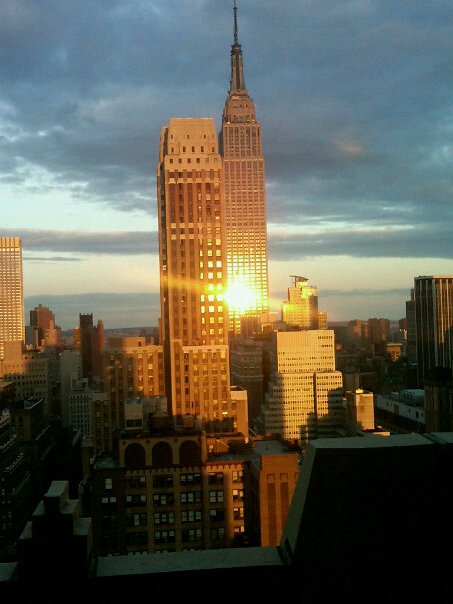 There is much that is ending in our industry. But something very valuable remains, and we will and ought to cling to it. The humane interchange at Barnes & Noble twice yearly proves that to me. And my recent face-to-face visits with Yankee Book Peddler and Diamond Comics have proven to me that in frank discussion and one-on-one exchanges, people can hone and improve commerce so much more quickly than can the lifeless green of an excel chart.
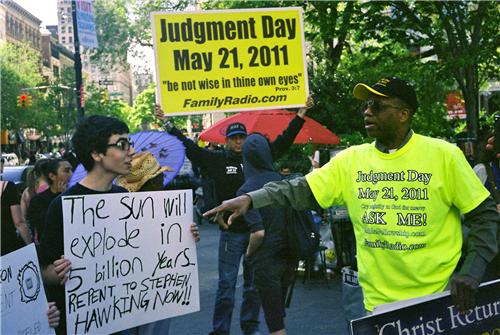
Any day at Barnes & Noble, those of us from university presses awaiting appointments in what is called the bull pen join together at lunch somewhere. We share stories of the road, of current practice, hijinks, nonsense, troubles and joys. And this round, with a May day that was to die for, three of us, now fully middle-aged men sat in the sun in Union Square Park, and shared this. All around people, rather normal looking citizens of the empire, carried placards and handed out pamphlets. Apparently they were in the sincere belief that this Saturday, May 21, will be the end of the world. There were so many doomsayers that the regulars in the bull pen declared this coming week’s dress code to be all black, doom’s color.
Homeless men on benches gladly took the brochures, and read them with real concern. The woman I nodded to and thanked for my copy looked no more delusional than the average housewife in from Cranford, New Jersey. End times. We three salesmen shared the horrors and rumors and amazements after a reasonable lunch. We looked, in our suits, the same as salesmen after lunching in so many other spring days in Manhattan. So long as we kept our cellphones in our pockets, and smiled at the sun, or stared in wonderment at the placards, or in sadness at our aging hands, we were like businessmen lounging in so many other decades in America’s brief imperial tableau….
This is the stuff and these are the times for great fiction, such as the body of work that is Joseph Roth’s. Late in Empires, when end fears run rampant, that is when the light is best, the moment is most poignant. Why fiction? It compresses emotion and narrative and polishes aside the temporal to shine the universal, what we lovest well and what we loath, and what must remain, like it or not.
 Even at those companies that worship at the altars of spreadsheets and try to communicate only through the screen of world class portals, I am finding that when a crisis becomes acute enough… there is no salvation like human contact. Somehow men and women, friends and colleagues such as we three that day before Armageddon will wait and gossip on those benches in the spring sun. We will await our appointments. And after rest and reflection, we will return to the task of putting the great work of authors in the hands of readers some way. World without end…. Amen.
 Fiction and History
2 responses to “End times and why we write fiction from history”
[…] eloquently takes on the book industry, tv preachers, the necessity of fiction, and End Times in a wonderful post over at Fiction and History. We three salesmen shared the horrors and rumors and amazements after […]
Beautiful. Thanks for this, Steve.