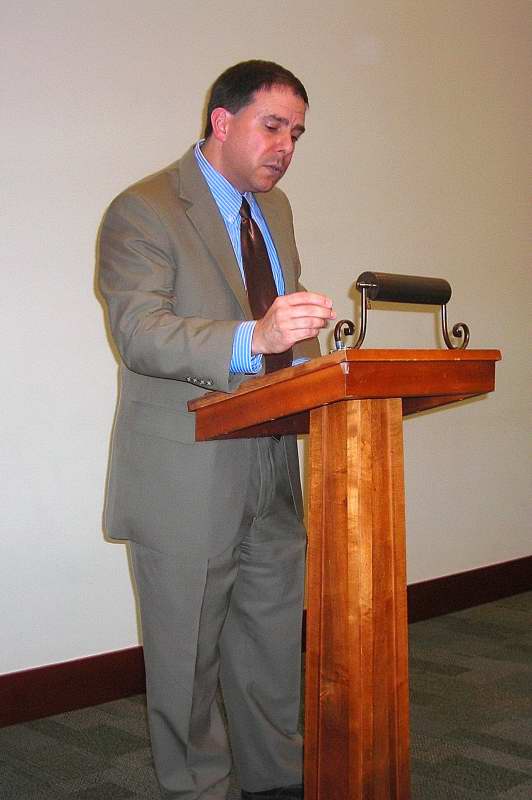
 Watching time and leaving a chunk of it for questions didn’t allow me to read from Morkan’s Quarry when I spoke August 11 at History is Lunch. I wouldn’t trade the fifteen minutes of Q&A we exchanged Wednesday at the Winter Archives for the world! But below is what I would have read from the novel, a snippet of what was once published in The Missouri Review.
Here’s our set up: Michael Morkan and his son Leighton Shea are headed for the bank to get their savings on what would have been roughly August 11 in Springfield in 1861. Leighton has earlier disobeyed his father and used black powder at the quarry, when Michael wanted to keep things quiet, so Michael is miffed.
from Morkan’s Quarry (Moon City Press 2010)
Riding to the center of town, they passed the courthouse, Morkan stone thrust into the sky. Blazing white, the stone was their best work by far and Michael Morkan panged to see it sit unfinished. With such a long project to focus on, Leighton had honed his skill at masonry, his angles and bevels achieving a smoothness as if all that met his chisel and mallet were butter rather than the hard, bitter lime. The joints and lines of the walls met the plumb lines with grace as he mortared. Morkan knew the boy possessed talent well beyond his own. In a slurry of pride and envy he noted townspeople marveling when Leighton ran a shift on the courthouse worksite. Farmers and their wives and daughters in from the hills gawked from their tailgates. Judges, lawyers, and clerks whiled away lunches watching the boy stonemason. Leighton reveled in the attention, and if the audience were large, he would neglect the quarry and stay on site until Morkan fetched him.
The streets were lined with saloons and chandler and tack shops, stout wooden columns supporting the balconies. Some merchants and their families huddled on the balconies despite the heat that shimmered up from the road. People leaned against the columns and massed along the wooden boardwalk. The wagons of the Federal Greene County Home Guards were braked in front of shops, and the Guards formed lines leading from the shops to the back of the wagons. Troops passed goods hand-to-hand from the doors to the wagons where the teamsters stacked the goods. Bolts of cloth, kegs of molasses, corn in boxes, crates of whiskey, sacked flour, shirts, boots, shovels, axes, and from the National Mineral Bank bags of currency. The Home Guards worked with the urgency and order of ants moving a nest of eggs. As he and his father neared a general store, Leighton noticed the two flags—State and Federal—usually displayed prominently from the columns of the store, had been taken down.
Where the storefront met the bank’s facade, a crowd gathered. Men and women were jostling and cursing. In the midst of a staunch circle of Home Guards, Claus Weitzer, one of the bank’s trustees, stood purple faced and hollering. A tall German with a sharp goatee, he always wore a black woolen vest and round-tailed wool coat regardless of weather. “Major receipts! Major receipts! Please!” It was a plea, the words barely intelligible over the crowd’s wrangling.
Morkan dismounted and gave Leighton the reins. “If there’s trouble,” he had to shout above the crowd, “head for that alley.” He pointed at the alley between the store and a smithy.
Morkan elbowed his way into the knot of people. A farmer named Owen drew back a fist, but was pushed aside by two other men shoving forward. Morkan reached the front and caught Weitzer’s eyes. The German continued shouting; he glanced at a receipt handed from the crowd, shook his head, handed the receipt to a Home Guard. The soldier grabbed the woman who had extended the receipt. As he led her away by the collar of her traveling dress, she screamed and kicked, white flounces pumping.
From his coat, Morkan withdrew his purple and gold embossed currency receipt and handed this to Weitzer. Morkan felt his jaw bind. Cash was no easy thing to come by. Some of his customers still paid in vegetables and fodder, or pennies a week. Most of this $2,500 he accrued working for the Kansas-Pacific surveying ahead of and around the rail lines, buying the choicest land and re-selling it at wonderful profit to speculators in St. Louis and Chicago. After witnessing the disappearance of wildcat banks that followed the lines, it took him years of studying Weitzer’s bank before he trusted it with his money. Seeing the swirling crowd, the cavalry scouts coursing by, Morkan expected to feel a soldier’s grip at his elbow the minute Weitzer read the receipt.
Still shouting for silence and civility, Weitzer tapped one of the soldiers on the back. Morkan clenched his fists. When the soldier turned, Weitzer flashed two fingers and pointed toward the bank. There, Home Guards were relaying the bank’s gold to the wagons.
In the street, cavalry sprinted past, heading north. Some stopped, whistled shrilly and began forcing townspeople onto the wooden boardwalks.
Two Home Guards descended the steps of the bank, each cradling a canvas satchel. Morkan struggled, swimming to remove himself from the crowd. The Guards with the bags followed him to the horses.
Morkan took a satchel from one soldier and clumped it against the boardwalk. He knelt, undid the thongs. The bag was only full enough to hold three hundred, if that. Double eagles, eagles, even silver dollars were mixed with the little gold Indian heads, so Morkan could not tally exactly what they had brought. The other Home Guard plunked his bag down and walked away. Morkan looked up at the remaining Guard.
“The trustee’s own money,” the Guard said over the fracas.
“Piss on him. What’s a trustee for?” Morkan extended his hand. “The receipt.”
The Guard gave him the paper. “Lucky a Dutchman would give you a dime, mick.”Morkan buried the satchel beneath a raincoat he kept in his saddlebag. He wadded Leighton’s rain gear and crammed the second satchel in Leighton’s bag. He wanted to leave for Galway before the army arrived and clogged the street, but he could see they were too late. When he sawed his horse around, people scrambled aside.
From the south, dust rose off a column of riders. Morkan swung his horse into the alley between the general store and a blacksmith’s and waved at Leighton to follow him. Once he was in, their horses stood jostling for a moment, then playfully nipped at each other’s necks and halters.
“Is it the Rebels?” Leighton asked.
Morkan shrugged and put a finger to his lips. He wished he could draw his pistol and take the rest of his money, but so long as either army was around fresh from battle, he would do his best not to show a gun. A new, six-foot high fence bottled the back of the alley, and he cursed this; a week ago the alley had gone through to Jefferson Avenue. He wanted to tear down the tin water spout from the store, wrench the thing around and chuck it in the street. Earlier in the day, despite Morkan’s expressly forbidding it Leighton had used black powder on stone at the quarry, had risked everything in his rush, in his brashness. Claus Weitzer had forfeited $1,500 to the damned Federals. And now a defeated army was between him and home in Galway. Cavalry churned in the street.
“Do you see this, Leighton?”
Leighton bowed his head.
“More than half of what we saved is gone, and you may as well set that powder out in the damned street.” He grabbed Leighton’s elbow, nearly jerked him off the horse. “Look at me!”
Leighton did, fiercely, his close set eyes surly and dull. Morkan gave him a last shake and let him go. When he did, Leighton was tempted to urge his horse on, leave Morkan to the Rebels, or whomever Morkan feared.
People on a balcony across the street clustered to face south. A man in red suspenders was pouring amber liquor from a bottle into the cups of everyone gathered at the balcony’s rail. Even the women did not refuse. Leighton remembered his late mother drinking only on holidays, and then in extreme moderation. The railroads Morkan had worked for often held small holiday parties. Morkan was a surveyor, crew chief, and eventually a designer for the Baltimore and Ohio Railroad’s western office and later the Kansas Pacific in St. Louis before buying the quarry at auction in 1856. At these parties, Charlotte drank sherry, and after two glasses she did not become loud or immoderate as Leighton had seen some women do. She became grave, inquisitive, would retire with her son to one of the hostess’s side rooms as if Leighton were ill. Then, and only then did she tell Leighton of Ireland, of seeing his father in a dream on All Hallows, a tall man returning to his village wearing a coat embroidered like the veins of a leaf. In the dream, when the tall man extended his hands, they were raw and burned. She sipped the yellow Sherry as if it were medicine. Though they could hear Morkan laughing and chatting with the railroad men, mother and son did not emerge until sent for.
Across the dusty street, a woman in a purple traveling dress and matching hat finished an entire glass in one draw. Though he sat quite close to Morkan, he gripped his elbows and held himself, for the alley was suddenly very wide.
After cavalry and flag bearers, there came teams of sweat-smeared horses dragging artillery pieces. Two wagons passed, their canvasses ripped and pocked with singed holes. A troop of soldiers trudged into the sunlight. Their shirts were open, their light blue pants ripped. Blood and soot smeared their faces, and bandages swaddled their limbs. Some looked to be Leighton’s age or younger.
“God Almighty,” Morkan whispered.
Uniforms on the troopers changed from blue to simple workshirts, light blue, white, butternut. Some stumbled from the ranks to the doors of the shops, some into the arms of friends and family. They saw Asa Martin gather his wife and two daughters in his arms and herd them along with him. With his rifle stock dragging in the dust, Andrew Lohman, a young bank clerk, shook his head and frowned dismally at an older couple on the balcony. He shouted something to them, and waved both hands north. Mounted officers dashed back and forth shouting orders, forcing men into rank with lunges from the horses.
Leighton could scarcely believe this was the army he’d seen bivouacked in the fields around town, stabbing bayonets on the square and marching. The pale, bloodied faces, the blackened, powder-streaked uniforms. Dark crescents clung under their eyes. Scores of wagons banged behind the troops. In the last cordon of wagons, men were stacked like logs, bloody limbs dangling over the sideboards. Behind these soldiers came a stumbling troop of badly wounded men, some groping for the tailgates only to be kicked at by other wounded and shoved off by orderlies jogging at the wheels. There was no way this army would be coming to the quarry to demand the powder. Leighton’s shoulders rose, and for a moment he felt a guilty relief in watching a trooper hobble by using a musket for a crutch.
A trooper in blue bearing a comrade lurched into the alley. Leighton’s horse snorted and backed away. The soldier slung his companion against the side of the store where the man slumped as if dead. Only the thigh remained of the man’s right leg, and Leighton marveled at the black and crimson stump that jutted from his tattered trousers. The soldier who’d brought him swung a rifle off his shoulder and waved it at both Leighton and his father. The bayonet at the end of the rifle was jagged and black.
“Give him water,” he said. Dark circles bulged beneath his eyes and his bottom lip was cracked and bloody.
Morkan edged his horse forward and extended his canteen. The soldier swung the muzzle at him. “And get down. I’m taking that horse.”
With a flick of his wrist Morkan flung the canteen which struck the soldier in the face. The soldier winced and cursed, his rifle clattering to the ground. Morkan whipped the Colt from its holster, cocked it and leveled it at the soldier.
The soldier blinked. Leighton drew the pepper-box from his pocket. The soldier knelt slowly, his eyes darting from Leighton to Morkan. He reached for the strap of the canteen, and when he touched it, he snatched the canteen to his chest. He crouched before his friend. Watching the Morkans over his shoulder, he doled water to his companion until the wounded man choked and sat forward. The soldier jerked the canteen away, sealed it. With a last look at the Morkans, he plunged into the street.
The street cleared momentarily, and the billows of dust settled. Morkan edged his mount in front of Leighton’s and peered south. There were still knots of cavalry dashing about and the crowd was growing, barefoot men in dingy shirts, hill people. Such a crowd might become a mob.
Leighton dismounted and knelt with his canteen to the wounded soldier. Unstopping the cork, he touched the wounded soldier’s lips with the bottle. Water surged down the soldier’s chin, and he lurched and grabbed Leighton’s arm.
“It’s water,” Leighton said, struggling against him.
The soldier’s eyes were yellowed. He released Leighton, and his mouth fell open with a dry smack. Leighton eased water past his lips, and the soldier gulped and choked. Leighton held the canteen back while the soldier recovered. Beneath his shoulder was a red band on which someone had embroidered EMPORIA in capital letters. A Kansan right here, a jayhawker, a killer’s killer. Leighton shivered. The Kansan wore a thin brown goatee and bushy sideburns. His uniform was fairly clean and still buttoned and whole save for the trouser leg, which erupted in ooze. From this amputation came the strong stench of tar. Leighton swallowed and felt dizzy in the heat.
When he looked up, the soldier was blinking at him.
“Damn secesh,” the soldier croaked.
“Get away from him,” Morkan said, wheeling his horse toward them. When Leighton turned, he saw his father had the revolver drawn again. “Leave him the canteen.”
 Fiction and History